Take the real Texas written test online!

Texas Road Signs Test

4.8 out of 5 (823 votes)
80% Passing score
10 Questions
2 Mistakes allowed
A Texas road signs practice test is not just extra review material tossed on top of the real licensing work. It is part of the work, or at least it should be treated that way. Road sign questions are built into the Texas driver license knowledge test, which is based on the Texas Driver Handbook from the Texas Department of Public Safety. So when you study signs, markings, colors, shapes, and those little instruction-heavy traffic situations that look simple until they are not, you are reviewing material that ties directly into the Texas permit test. This Texas DPS signs practice test gives you 20 multiple-choice questions focused on the road signs Texas drivers are expected to understand without overthinking them forever. That includes regulatory signs, warning signs, guide signs, school-zone signs, construction signs, railroad crossings, lane-use signs, and pavement markings. And yes, some of it feels obvious at first glance. A stop sign is a stop sign. Fine. But the test is not only checking whether you recognize the red octagon. It is checking whether you understand what the sign requires you to do, how quickly you can read the situation, and whether you can avoid turning a basic rule into a wrong answer because the wording nudged you half an inch off track. For ordinary Class C applicants in Texas, there usually is not a separate road-sign-only test. Road signs are tested as part of the main knowledge testing process, along with traffic laws, right-of-way rules, safe driving practices, alcohol and drug laws, distracted driving, vehicle equipment, and driver responsibility. The learner-facing Class C knowledge test format is commonly presented as 30 multiple-choice questions, with 21 correct answers required to pass. That is a 70% passing score, which means you can miss up to 9 questions. Sounds roomy, maybe, but not so roomy that you want to donate misses to signs you could have reviewed in ten minutes. Some applicants complete the knowledge test through an approved driver education course. Others take it at a driver license office, including teen applicants who did not take the knowledge exam during the classroom portion of driver education. Adult driver education final exams may also split attention between road rules and road signs, which is another reason sign practice is worth taking seriously. Use this Texas road signs practice test as focused preparation for the bigger Texas DPS practice test picture. It sharpens the sign knowledge you need for the permit test, and it keeps that knowledge connected to the licensing process that comes after the studying is done.

Skip the DPS written test. No Joke.

Pass guaranteed — or your money back.

Learn More
Promotion
Learn More

Sample Texas Permit Test Questions

Question 1

A police officer directs you through an intersection while your signal is red. What should you do?
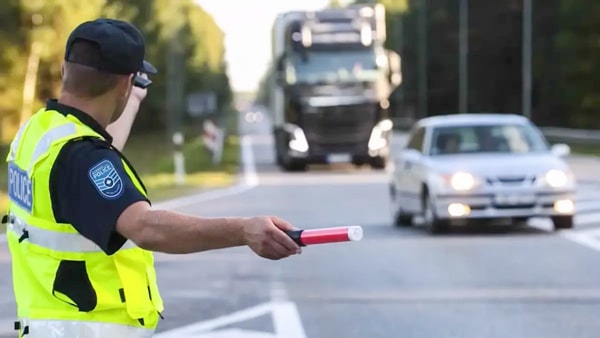
A traffic light is red, but a police officer is telling you to go ahead anyway. What should you do?
  1. A Remain stopped until the signal turns green
  2. B Change lanes before entering the intersection
  3. C Follow the officer’s lawful direction
  4. D Wait for the officer to come to your vehicle

Correct answer: C – Follow the officer’s lawful direction

Texas law prohibits willfully failing or refusing to follow a lawful order or direction from a police officer. If the officer directs you to proceed while the signal is red, follow that direction carefully. The officer’s instruction controls your movement in that situation.

Source: Tex. Transp. Code § 542.501 – Obedience Required to Police Officers, School Crossing Guards, and Escort Flaggers

Question 2

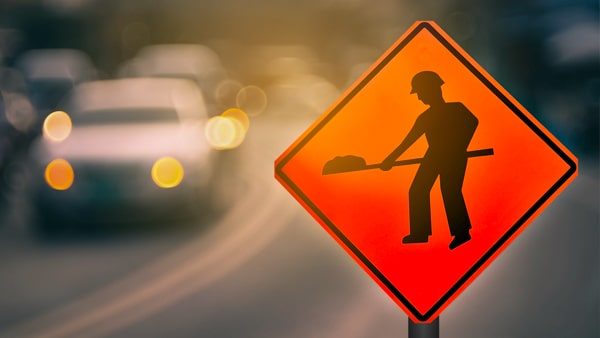
What does an orange diamond sign showing a worker with a shovel warn you about?

This sign means that:
  1. A A volunteer litter pickup area
  2. B Workers in or near the roadway
  3. C A playground beside the road
  4. D A pedestrian crossing

Correct answer: B – Workers in or near the roadway

The Workers sign alerts road users that workers may be in or near the roadway. It is used in temporary traffic-control areas and may appear before the work activity. Drivers should watch carefully for workers and changing roadway conditions.

Source: 2025 Texas Manual on Uniform Traffic Control Devices — § 6H.18, “Workers Signs (CW21-1 and CW21-1bT)”

Question 3

On a standard vertical three-section traffic signal, what is the order of the lights from top to bottom?

From top to bottom, the following is the proper order for traffic lights:
  1. A Red, yellow, green
  2. B Red, green, yellow
  3. C Green, red, yellow
  4. D Green, yellow, red

Correct answer: A – Red, yellow, green

In a standard vertical signal face, the red lens is above the yellow and green lenses. The circular yellow lens is positioned between the red lens and the green lens. The resulting top-to-bottom order is red, yellow, and green.

Source: 2025 Texas Manual on Uniform Traffic Control Devices — § 4D.16, “Number and Arrangement of Signal Sections in Vehicular Traffic Control Signal Faces”

Question 4

At a stop sign, where must you stop first?

  1. A Where you can see traffic on the intersecting road
  2. B After entering the crosswalk
  3. C At the stop line, or before the crosswalk if no line exists
  4. D At least five feet before the sign

Correct answer: C – At the stop line, or before the crosswalk if no line exists

In Texas, stop at the clearly marked stop line. If there is no stop line, stop before entering the near-side crosswalk. When neither a stop line nor a crosswalk exists, stop at the nearest point from which you can see approaching traffic on the intersecting roadway.

Source: Tex. Transp. Code § 544.010(a), (c) – Stop Signs and Yield Signs

Question 5

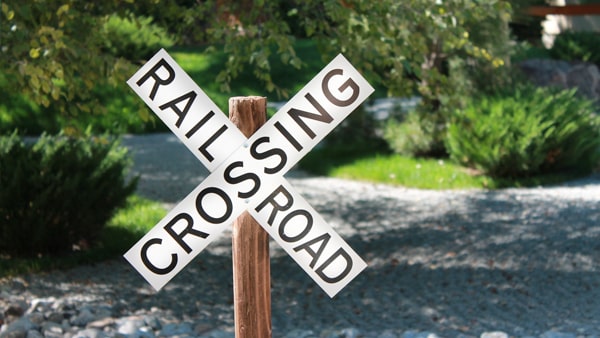
What does a white X-shaped sign marked RAILROAD CROSSING identify?

This road sign means:
  1. A An intersection where you stop only for highway traffic
  2. B A three-way highway intersection
  3. C A crossroad ahead
  4. D A railroad grade crossing

Correct answer: D – A railroad grade crossing

The crossbuck identifies the location of a railroad grade crossing. In Texas, it requires road users to yield the right-of-way to rail traffic. Check for an approaching train and be prepared to stop; the crossbuck does not by itself require a stop when no train is approaching.

Source: 2025 Texas Manual on Uniform Traffic Control Devices — § 8B.03, “Grade Crossing (Crossbuck) Sign (R15-1) and Number of Tracks Plaque (R15-2P) at Active and Passive Grade Crossings”

Question 6

What must you do when facing a red-and-white, downward-pointing triangular sign?

  1. A Stop only for an approaching emergency vehicle
  2. B Continue after looking both ways
  3. C Always make a complete stop
  4. D Slow to a reasonable speed and yield, stopping if safety requires

Correct answer: D – Slow to a reasonable speed and yield, stopping if safety requires

A yield sign requires a Texas driver to slow to a speed reasonable for the conditions and yield to vehicles in or dangerously close to the intersection. A complete stop is required when safety demands it. If the way is clear and stopping is unnecessary, the driver may proceed cautiously.

Source: Tex. Transp. Code § 544.010(b), (c) – Stop Signs and Yield Signs, Tex. Transp. Code § 545.153(c) – Vehicle Entering Stop or Yield Intersection