Take the real Texas written test online!

Texas Road Signs Test Simulator

4.8 out of 5 (535 votes)
80% Passing score
25 Questions
5 Mistakes allowed
A Texas DPS practice test should do more than shuffle you through a few obvious road signs and call it good. The better use of your time is a simulator that forces you to recognize signs quickly, understand what they mean, and get comfortable with the kind of wording that can show up on the Texas permit test. This one gives you 20 road sign questions per round, pulled from a larger question bank, so you are not just rehearsing the same little set of answers until your brain goes on autopilot — which, honestly, is a terrible way to study for anything involving actual driving. Road signs are part of the Texas Class C knowledge test, not some extra piece tacked on at the end. The real test is multiple choice, with 30 questions total, and you need 21 correct answers to pass. That is 70%, or, put another way, only 9 misses before the whole thing stops being a “pretty good attempt” and becomes a retake. The test also covers traffic laws, right-of-way, safe driving habits, alcohol and drug rules, distracted driving, vehicle equipment, and driver responsibility, so the road sign section needs to be solid before you start worrying about everything else. This Texas DPS practice test keeps the focus where a lot of applicants need it: sign recognition, sign meaning, and how those signs apply when you are actually on the road. Warning signs, regulatory signs, guide signs, odd little symbols you think you know until you see four answer choices sitting next to each other — it all needs repetition. After each attempt, you get a review of what you missed and the correct answers, which is the part that actually turns a missed question into something useful. Teens working toward a learner license can use this practice test alongside driver education. Adults 18 through 24 can use it while completing the required 6-hour adult driver education course. Applicants 25 and older, who are not required to take driver education, can still use it before dealing with the knowledge test, vision exam, documents, fees, and the rest of the DPS process. It is a road sign practice test, yes, but it is also a cleaner way to walk into the Texas driving test knowing you have already handled one of the easiest sections to overlook.

Skip the DPS written test. No Joke.

Pass guaranteed — or your money back.

Learn More
Promotion
Learn More

Sample Texas Permit Test Questions

Question 1

A yellow diamond sign displays a long, winding arrow. What condition does it warn of?
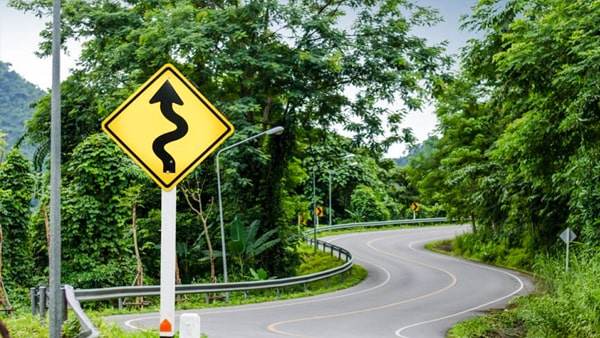
This sign tells you that:
  1. A Turns are prohibited ahead
  2. B The roadway becomes narrower
  3. C A winding section of road is ahead
  4. D The pavement becomes slippery when wet

Correct answer: C – A winding section of road is ahead

The winding-road sign warns that a series of curves is ahead. Drivers should reduce speed as appropriate before entering the winding section, drive carefully, and avoid passing. A separate slippery-when-wet sign uses a vehicle with skid marks rather than a winding arrow.

Source: Texas Driver Handbook — Ch. 5, “Warning Signs”

Question 2

A yellow warning sign shows the pavement edge with a lower shoulder beside it. What hazard does it identify?

What should you be most concerned about when you see this sign?
  1. A Headlights may become misaligned on the uneven road
  2. B A tire will necessarily be damaged on the shoulder
  3. C Water on the shoulder will always cause hydroplaning
  4. D A wheel dropping onto the lower shoulder could affect vehicle control

Correct answer: D – A wheel dropping onto the lower shoulder could affect vehicle control

The sign warns of a drop between the traveled pavement and the shoulder. If a wheel leaves the pavement, sudden hard braking or a sharp attempt to return can make control more difficult. The driver handbook recommends releasing the accelerator, braking carefully, reducing speed, checking traffic, and then returning gradually to the pavement.

Source: Texas Driver Handbook — Ch. 5, “Warning Signs”, Texas Driver Handbook — Ch. 9, “Running Off the Pavement”

Question 3

A freeway sign showing the distance to an upcoming exit normally uses which color combination?

  1. A Black lettering on a yellow background
  2. B White lettering on a black background
  3. C White lettering on a red background
  4. D White lettering on a green background

Correct answer: D – White lettering on a green background

Under Texas traffic-control standards, ordinary freeway guide signs display white letters, symbols, arrows, and borders on a green background. Interchange advance guide signs may identify the approaching exit and its distance. Other colors are reserved for different purposes, such as warnings, regulations, or motorist services.

Source: Texas Manual on Uniform Traffic Control Devices 2025 § 2E.09 – Color of Guide Signs, Texas Manual on Uniform Traffic Control Devices 2025 § 2E.23 – Interchange Advance Guide Signs (E1-1 through E1-3)

Question 4

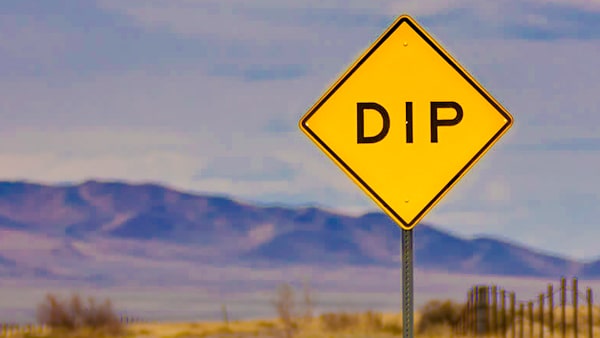
A yellow diamond-shaped sign displaying the word “DIP” warns of:

This sign means:
  1. A A depression in the roadway ahead
  2. B A shoulder that cannot support vehicles
  3. C A pedestrian crossing
  4. D A required stop

Correct answer: A – A depression in the roadway ahead

A DIP sign warns that a sharp depression lies ahead in the roadway profile. It allows drivers to recognize the roadway condition before reaching it. The sign does not indicate a soft shoulder, pedestrian crossing, or stop requirement.

Source: Texas Manual on Uniform Traffic Control Devices 2025 § 2C.26 – BUMP and DIP Signs (W8-1 and W8-2)

Question 5

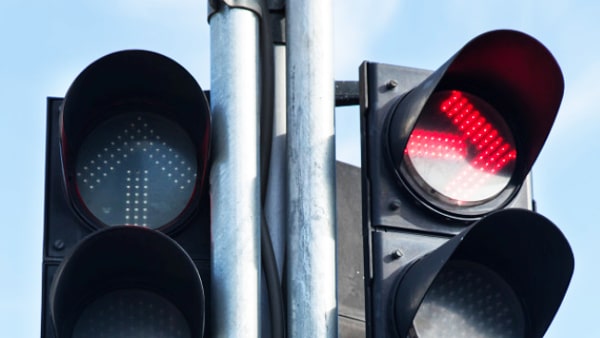
When a steady red arrow points right, what must you do before making the indicated turn?

A red arrow pointing to the right on a traffic light means you may:
  1. A Stop, then turn whenever cross traffic clears
  2. B Remain stopped until a signal or device permits the turn
  3. C Slow down and turn without stopping
  4. D Turn if vehicles behind you are waiting

Correct answer: B – Remain stopped until a signal or device permits the turn

Under the current Texas traffic-control standard, traffic facing a steady red arrow may not enter the intersection to make the movement indicated. The driver must stop and remain stopped until a signal indication or another traffic-control device permits that movement. This differs from the rule for an ordinary circular red signal.

Source: Texas Manual on Uniform Traffic Control Devices 2025 § 4D.04 – Meaning of Steady Signal Indications

Question 6

What does a single solid white line between lanes generally indicate?

  1. A Crossing the line is always prohibited
  2. B Crossing the line is discouraged
  3. C Traffic moves in opposite directions
  4. D Passing is required before the line ends

Correct answer: B – Crossing the line is discouraged

A single solid white lane line indicates that crossing the line is discouraged. It is different from a double solid white line, which marks a location where crossing is prohibited. If a driver changes lanes where the movement is otherwise lawful, the driver remains responsible for making the movement safely.

Source: Texas Manual on Uniform Traffic Control Devices 2025 § 3B.06 – White Lane Line Pavement Markings, Tex. Transp. Code § 545.103 – Safely Turning