
Take the real Texas written test online!

Texas Drivers License Practice Test 2

4.8 out of 5 (1664 votes)
80% Passing score
20 Questions
4 Mistakes allowed
A Texas driver’s license practice test should do more than toss a few road signs at you and call it a day. The real DPS knowledge test is based on the Texas Driver Handbook, and it covers a wider stretch of material than many people expect: traffic laws, right-of-way, road signs, alcohol and drug rules, distracted driving, safe driving habits, vehicle equipment, and the basic responsibilities that come with having a license. That sounds like a tidy list. It is not always tidy when the questions start asking how those rules actually work in traffic. This Texas driving test practice is the second test in the series, with 20 carefully chosen questions that help you get used to the kind of thinking the official exam expects. The Texas Class C knowledge test is multiple choice, and the real version has 30 questions. You need 21 correct answers to pass, so there is room to miss a few, but not enough room to treat the handbook like background noise. Road signs are included, and yes, they matter beyond just recognizing the obvious ones. The practice test is useful for teens preparing for a learner license, adults applying for the first time, and older drivers who want to refresh what they know before dealing with DPS. Teen applicants generally need to be at least 15, be enrolled in or have completed approved driver education, pass the knowledge exam, pass the vision exam, and bring the required documents. Adults ages 18 to 24 have their own extra step, too: Texas requires a 6-hour adult driver education course for first-time applicants unless an exception applies. Applicants 25 and older are not required to complete driver education, though DPS still recommends it, and they still need to meet the testing and document requirements. There are transfer rules mixed in as well, because Texas does not treat every out-of-state situation the same. A new resident with a valid, unexpired out-of-state license may avoid some testing, but vehicle registration and insurance proof can still come into play. Teen transfers are more restricted and may still have to hold a Texas learner license for six months. Use this Texas permit test practice to find the weak spots before DPS finds them for you. It is free, focused, and built to make the official Texas drivers license test feel a lot less foggy.

Skip the DPS written test. No Joke.

Pass guaranteed — or your money back.

Learn More
Promotion
Learn More

Sample Texas Permit Test Questions

Question 1

When a large truck signals a right turn, what should a nearby driver recognize?

  1. A The truck may need extra roadway space to make a wide turn
  2. B The truck must remain next to the right curb throughout the turn
  3. C The truck may turn into whichever lane has less traffic
  4. D The truck automatically has the right-of-way over all traffic

Correct answer: A – The truck may need extra roadway space to make a wide turn

Large trucks have a wide turning radius, and their rear wheels need clearance from the curb. A truck may move left or leave open space on its right while setting up for a right turn. Do not attempt to pass on the truck’s right when it may be turning.

Source: Texas Driver Handbook — Ch. 9, “Share the Road with Trucks (Large Trucks and Truck-Tractor Combinations)”, Texas Commercial Motor Vehicle Driver’s Handbook — § 14.6, “Right Turns with Large Equipment”
Question 2

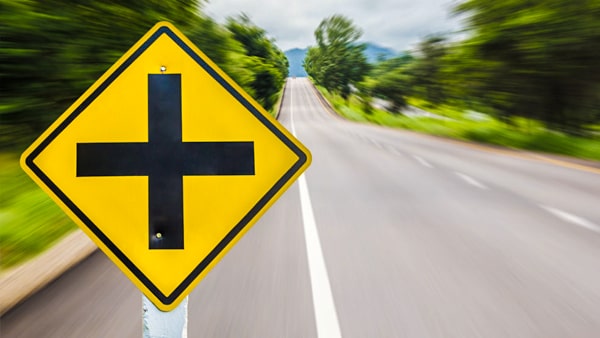
A yellow diamond sign showing one road crossing another warns of what?

This sign shows one type of:
  1. A A crossroad intersection ahead
  2. B A sharp curve ahead
  3. C A required right turn
  4. D A lane shift ahead

Correct answer: A – A crossroad intersection ahead

This warning sign identifies a crossroad intersection ahead. Drivers should watch for vehicles that may enter or cross their path from either side. The sign warns of a roadway condition; it does not require a turn or lane change.

Source: Texas Driver Handbook — Ch. 5, “Warning Signs”

Question 3

Traffic is backed up beyond a railroad crossing. What must be true before you cross?

  1. A The nearest train must appear to be moving slowly
  2. B There must be enough space to clear every track without stopping
  3. C At least half of your vehicle must fit beyond the first rail
  4. D No train may be visible from your current position

Correct answer: B – There must be enough space to clear every track without stopping

Enter a railroad crossing only when enough space exists beyond it for your entire vehicle. The Texas handbook directs drivers never to stop on railroad tracks, and state law prohibits stopping on a track. Wait before the crossing if traffic ahead could leave any part of your vehicle over the rails.

Source: Tex. Transp. Code § 545.302(a)(8) – Stopping, Standing, or Parking Prohibited in Certain Places, Texas Driver Handbook — Ch. 4, “Additional Safe Driving Procedures at Railroad Crossings”

Question 4

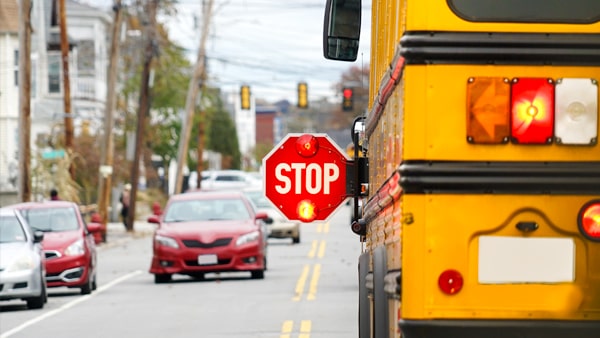
Under Texas law, what must you do when a stopped school bus is displaying its required flashing red signal?

What does it mean when a school bus is stopped and its red lights are flashing?
  1. A Pass carefully if no student is visible
  2. B Stop and remain stopped until a legally permitted condition allows you to proceed
  3. C Stop only when approaching the bus from behind
  4. D Pass at reduced speed when approaching from the front

Correct answer: B – Stop and remain stopped until a legally permitted condition allows you to proceed

You must stop before reaching the bus. You may proceed only when the bus resumes motion, the bus driver signals you to proceed, or the visual signal is no longer operating; separate-roadway exceptions apply. A first offense carries a $500–$1,250 fine, while a qualifying repeat offense within five years carries a $1,000–$2,000 fine.

Source: Tex. Transp. Code § 545.066(a)–(c) – Passing a School Bus; Offense

Question 5

Why does alcohol-impaired driving endanger people who do not drink?

  1. A It affects only the impaired driver’s vehicle
  2. B It reduces driving ability and places everyone sharing the road at risk
  3. C It matters only when a police officer observes it
  4. D It creates danger only for passengers who have been drinking

Correct answer: B – It reduces driving ability and places everyone sharing the road at risk

Alcohol can impair coordination, judgment, perception, and emotional control. It can also slow reactions and interfere with a driver’s ability to judge another vehicle’s speed or distance. Because an impaired driver interacts with other vehicles, pedestrians, and roadway users, impaired driving is a safety problem affecting everyone on the road.

Source: Texas Driver Handbook — Ch. 10, “Alcohol and Drug Impact on the Driving Ability”

Question 6

At a stop sign with no marked stop line, where must you stop if a crosswalk is present?

  1. A At the corner after entering the crosswalk
  2. B Before entering the crosswalk on the near side
  3. C Just beyond the intersecting roadway
  4. D At least 15 feet before the corner

Correct answer: B – Before entering the crosswalk on the near side

Texas law first requires a stop at a clearly marked stop line. If no stop line exists, stop before entering the crosswalk on the near side of the intersection. If neither a stop line nor a crosswalk exists, stop at the nearest place where you can view approaching traffic on the intersecting roadway.

Source: Tex. Transp. Code § 544.010(c) – Stop Signs and Yield Signs