Take the real Texas written test online!

Texas Practice Permit Test 4

4.8 out of 5 (1072 votes)
80% Passing score
20 Questions
4 Mistakes allowed
A Texas DPS practice test is useful long before anyone starts worrying about parallel parking or scheduling a road test. That includes teens aiming for a learner license, adults ages 18 through 24 who need the required 6-hour adult driver education course, and older first-time applicants who are not required to take driver ed but probably should not walk into testing cold. Texas gives drivers a few different ways into the licensing process, and honestly, the details can pile up fast if you only glance at them once. For teens, driver education may begin at age 14, but the learner license itself cannot be issued until age 15. Some students use the concurrent method, where they complete the first 6 hours of classroom instruction, take the written exam, get the learner license, and then keep working through the rest. Others use the block method and finish all 24 classroom hours before testing. Either route still leads into the real practice requirement: 7 hours of in-car observation, 7 hours of driving instruction, and 30 hours of supervised behind-the-wheel practice, with at least 10 of those hours at night. A licensed driver age 21 or older needs to be in the vehicle for those practice hours, which is one of those rules worth remembering because DPS is not casual about supervision. This Texas permit practice test gives you 20 multiple-choice questions and a passing score of 16 correct answers. It covers practical safety material, including correct child safety seat use and installation, along with the kind of rule-based knowledge that shows up when you are preparing for a Texas learner’s permit practice test or brushing up for the Texas driving test. You can take it more than once, review missed answers, and actually see where your memory is solid versus where it is doing that vague “I’m pretty sure” thing, which is not a study strategy, even if it feels like one. The practice test also fits neatly into Texas’s Graduated Driver License process. Phase I is the learner license stage, with driver education, the knowledge exam, vision exam, documents, fees, and supervised driving. Phase II is the provisional license stage for qualifying 16- and 17-year-olds who have held a learner license for at least 6 months, completed the required training, finished Impact Texas Teen Drivers within 90 days of the driving test, and passed the road exam. Provisional drivers still face restrictions on passengers, late-night driving, and wireless device use. So, no, a DPS test cheat sheet is not the smart shortcut here. A steady Texas DPS practice test is the better move.

Skip the DPS written test. No Joke.

Pass guaranteed — or your money back.

Learn More
Promotion
Learn More

Sample Texas Permit Test Questions

Question 1

A warning sign shows a short road joining the main roadway from the right. What does it indicate?
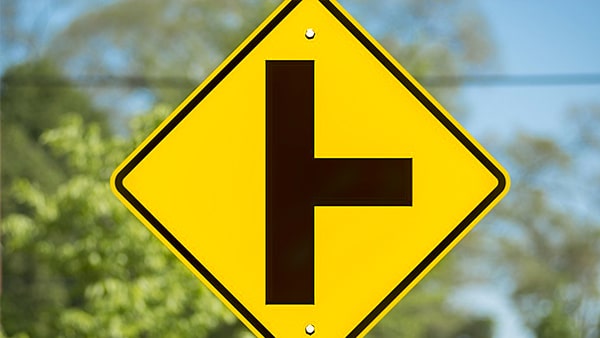
This sign means:
  1. A Right turn required
  2. B Side road ahead on the right
  3. C Straight movement only
  4. D Right turns prohibited

Correct answer: B – Side road ahead on the right

The Side Road warning sign alerts drivers to an intersection where another roadway enters from the indicated side. The symbol’s main line represents your roadway, and the shorter branch represents the joining road. Watch for vehicles that may turn or enter from that direction.

Source: 2025 Texas Manual on Uniform Traffic Control Devices — § 2C.41, “Intersection Warning Signs (W2-1 through W2-8)”
Question 2

Traffic is moving faster than the posted 45 mph limit. Which speed follows the posted limit?

  1. A 50 mph or more to match traffic
  2. B Any speed from 45 to 50 mph
  3. C 45 mph or less, with further reduction when conditions require

Correct answer: C – 45 mph or less, with further reduction when conditions require

Texas drivers are instructed to observe posted maximum speed limits even when surrounding vehicles are moving faster. A driver must also travel at a reasonable and prudent speed for existing traffic, weather, visibility, and roadway conditions. Those conditions may require driving below 45 mph, but faster traffic does not authorize exceeding the posted limit.

Source: Tex. Transp. Code § 545.351 – Maximum Speed Requirement, Texas Driver Handbook — Ch. 8, “Speed Limits”

Question 3

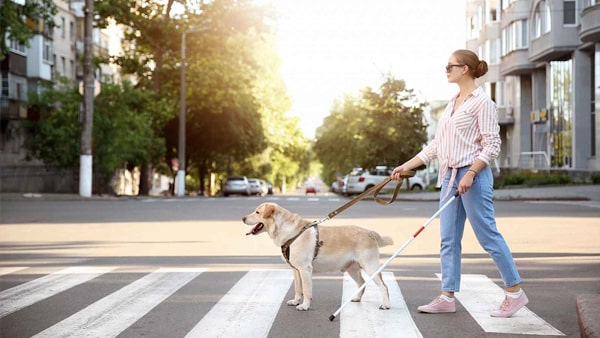
You are preparing to turn right while a pedestrian using a guide dog is crossing or attempting to cross in your path. What should you do?

You want to make a right turn at the corner. A pedestrian with a guide dog is at the corner ready to cross the street in front of you. Before making your right turn, you should:
  1. A Turn off the engine until the pedestrian leaves the area
  2. B Tell the pedestrian when to begin crossing
  3. C Yield and wait until the turn can be made without endangering the pedestrian
  4. D Honk before turning in front of the pedestrian

Correct answer: C – Yield and wait until the turn can be made without endangering the pedestrian

Texas law requires a driver approaching a crosswalk or intersection to take necessary precautions when a pedestrian guided by an assistance animal is crossing or attempting to cross. The driver must stop if stopping is necessary to avoid injury or danger. Do not turn across the pedestrian’s path until the conflict has cleared.

Source: Tex. Transp. Code § 552.010(b) – Blind Pedestrians

Question 4

Which statement correctly describes motorcycles in Texas traffic?

Which of these statements is true about motorcycles?
  1. A Their smaller profile can make them harder for drivers to see
  2. B Their speed is easier to judge because they are small
  3. C They may share a lane beside a car whenever space appears available
  4. D They always have the right-of-way

Correct answer: A – Their smaller profile can make them harder for drivers to see

A motorcycle has a much smaller profile than a passenger car, making it easier to overlook in traffic or a blind spot. Its distance and speed may also be harder to estimate. Motorcyclists have the same general rights and privileges as other vehicle operators and are entitled to use a full traffic lane.

Source: Texas Driver Handbook — Ch. 9, “Share the Road with Motorcycles”

Question 5

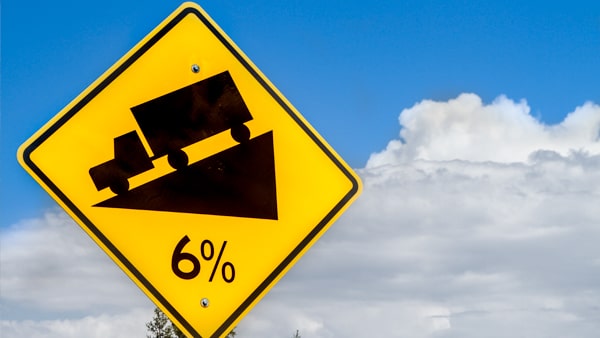
A warning sign depicts a truck descending a steep slope. What condition does it identify?

This sign means:
  1. A A truck weight restriction
  2. B A significant downgrade ahead
  3. C A truck service area
  4. D A roadway closed to trucks

Correct answer: B – A significant downgrade ahead

The Hill sign is placed before a downgrade whose grade, length, curvature, or other features require special precautions. It warns of the roadway condition rather than prohibiting trucks. A separate plaque may be added when drivers are advised to use a lower gear.

Source: 2025 Texas Manual on Uniform Traffic Control Devices — § 2C.14, “Hill Signs (W7-1 and W7-1a)”

Question 6

An oncoming vehicle’s headlights create strong glare at night. Where should you direct your vision?

When a car with bright headlights comes toward you at night, you should:
  1. A Toward the centerline
  2. B Directly above the headlights
  3. C Directly below the headlights
  4. D Slightly right, toward the lane or edge marking

Correct answer: D – Slightly right, toward the lane or edge marking

Do not look directly at bright oncoming headlights. Instead, look slightly to the right toward the right lane line or edge marking while maintaining awareness of the road ahead. Do not retaliate with your own high beams because that increases glare and collision risk for both drivers.

Source: Texas Commercial Motor Vehicle Drivers Handbook — § 2.11.5, “Night Driving Procedures”