Take the real Texas written test online!

Texas Road Signs Practice Test 4

4.9 out of 5 (283 votes)
80% Passing score
20 Questions
4 Mistakes allowed
A Texas road sign test is worth taking seriously, mostly because sign questions are baked into the larger Texas driver license knowledge test, not tucked away in some separate little road-sign-only exam for regular Class C applicants. That matters. When you sit for the official knowledge test, you are dealing with Texas traffic laws, right-of-way rules, safe driving habits, alcohol and drug laws, distracted driving, vehicle equipment, driver responsibility, and yes, road signs — all mixed together in one multiple-choice test. This practice test gives you a cleaner way to slow down and work on the sign portion by itself. There are 20 multiple-choice questions covering road sign shapes, colors, warnings, commands, and the meanings drivers are expected to recognize without turning it into a long debate in their own head. Red signs, yellow warnings, construction signs, regulatory signs, the odd little details about shape — they all matter more than people tend to admit. And, honestly, this is where a lot of drivers get a little too casual. They remember the obvious signs, then get fuzzy when the test asks about what a shape means before you can even read the words on it. The official Texas Class C knowledge test is commonly formatted as 30 multiple-choice questions, with 21 correct answers needed to pass. That is a 70% score, so you can miss up to 9 questions, which sounds comfortable until you remember that the test is pulling from several topics at once. A focused Texas DMV road signs test helps you protect those points. It does not replace the official exam, and it is not pretending to. It is permit test practice with a very specific job: make road signs feel familiar before they show up inside the real DPS testing process. It also works alongside the licensing path you are already on. Teen drivers generally move through Texas driver education before getting a learner license. Adults ages 18 through 24 need a 6-hour adult drivers ed course before testing for a first Texas license. Drivers 25 and older are not required to take drivers ed, though DPS recommends it for first-time applicants. Somewhere in that process, depending on your situation, you may also be dealing with documents, a vision exam, fees, and eventually the driving skills test. So, yes, this Texas DPS sign test practice is only one piece of the licensing puzzle. But it is a piece you can control early, and that counts for more than it sounds like.

Skip the DPS written test. No Joke.

Pass guaranteed — or your money back.

Learn More
Promotion
Learn More

Sample Texas Permit Test Questions

Question 1

Your light turns green, but vehicles already in the intersection still block your path. What should you do?

  1. A Wait until your path through the intersection is clear
  2. B Drive around the vehicles if space appears available
  3. C Enter the intersection and wait behind them
  4. D Sound your horn and proceed

Correct answer: A – Wait until your path through the intersection is clear

A green signal permits movement, but a driver must yield to vehicles lawfully within the intersection. Entering while the path remains blocked could interfere with those vehicles and leave your vehicle stopped in the intersection. Wait until the vehicles clear and you can proceed without conflict.

Source: Tex. Transp. Code § 544.007(b) – Traffic-Control Signals in General
Question 2

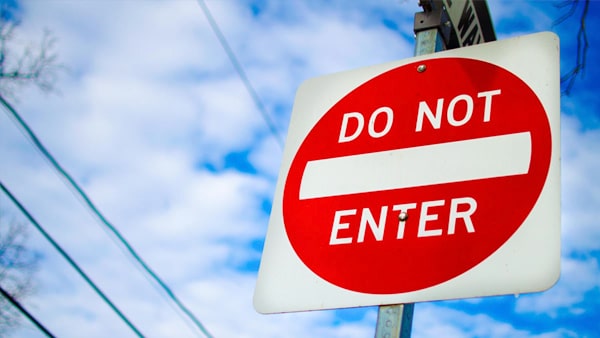
A red-and-white DO NOT ENTER sign means:

This sign means:
  1. A Stop, then continue straight
  2. B U-turns are prohibited
  3. C Yield before entering
  4. D Do not enter the roadway or ramp from this direction

Correct answer: D – Do not enter the roadway or ramp from this direction

A DO NOT ENTER sign prohibits entry from the direction in which the sign is facing. It is commonly placed where a driver could wrongly enter a one-way roadway, divided highway, or ramp. It is not a stop or yield sign and does not permit entry after waiting.

Source: Texas Manual on Uniform Traffic Control Devices 2025 § 2B.46 – DO NOT ENTER Sign (R5-1)

Question 3

Orange warning signs in a temporary traffic-control area alert drivers to:

  1. A Permanent highway closures
  2. B Road work or temporarily changed conditions
  3. C Ordinary regulatory speed limits
  4. D High-occupancy vehicle lanes

Correct answer: B – Road work or temporarily changed conditions

Texas temporary traffic-control warning signs generally have a black message and border on an orange background. They notify road users about work activities, obstructions, restrictions, and other temporary conditions on or near the roadway. Drivers should watch for additional signs, channelizing devices, and directions from flaggers.

Source: Texas Manual on Uniform Traffic Control Devices 2025 § 6H.01 – Warning Sign Function, Design, and Application

Question 4

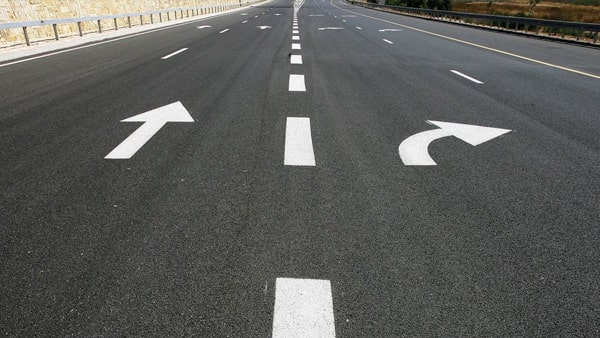
A broken white line separating two traffic lanes indicates that:

A broken white center line on the roadway means:
  1. A Turns from either lane are prohibited
  2. B Drivers must reduce speed immediately
  3. C The roadway is a no-passing zone
  4. D Drivers may change lanes when the movement can be made safely

Correct answer: D – Drivers may change lanes when the movement can be made safely

White lane lines separate traffic moving in the same direction. A broken white line is used where crossing the line with care is not discouraged or prohibited. Before changing lanes, a driver must determine that the movement can be made safely and signal the intended lane change.

Source: Texas Manual on Uniform Traffic Control Devices 2025 § 3B.06 – White Lane Line Pavement Markings, Tex. Transp. Code § 545.103 – Safely Turning, Tex. Transp. Code § 545.104(a) – Signaling Turns; Use of Turn Signals

Question 5

A steady yellow arrow appears while you are waiting in a dedicated left-turn lane. What does it tell you?

  1. A The turn is prohibited for the rest of the signal cycle
  2. B Accelerate before opposing traffic begins moving
  3. C The green-authorized movement is ending, and you must obey the next signal
  4. D You have unconditional right-of-way over intersection traffic

Correct answer: C – The green-authorized movement is ending, and you must obey the next signal

Texas law provides that a steady yellow signal warns that movement authorized by a green signal is ending or that a red signal is about to appear. A yellow arrow does not begin a new protected turn or grant unconditional priority. Watch for and obey the signal that follows it.

Source: Tex. Transp. Code § 544.007(a), (e) – Traffic-Control Signals in General
Question 6

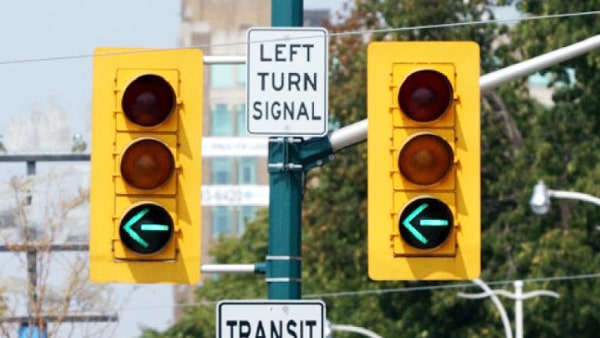
What does a steady green left arrow permit you to do?

A green arrow pointing to the left on a traffic light means you may:
  1. A Turn left or continue straight from the turn lane
  2. B Turn left only after first making a complete stop
  3. C Proceed cautiously in the arrow’s direction after yielding to lawful intersection users
  4. D Turn without checking for vehicles or pedestrians

Correct answer: C – Proceed cautiously in the arrow’s direction after yielding to lawful intersection users

A green arrow authorizes movement in the direction indicated by the arrow. The driver may cautiously enter but must stop and yield to pedestrians lawfully in an adjacent crosswalk and yield to other traffic lawfully using the intersection. The arrow does not excuse a driver from avoiding a collision.

Source: Tex. Transp. Code § 544.007(c) – Traffic-Control Signals in General