Take the real Texas written test online!

Texas Permit Practice Test 5

4.8 out of 5 (925 votes)
80% Passing score
20 Questions
4 Mistakes allowed
This Texas DPS practice test starts where good prep should start: with the material you actually need to understand before you sit for the official exam. It uses 20 questions focused on driving under the influence, including Texas DUI rules, blood alcohol concentration limits, and the consequences that follow impaired driving. Not soft, general safety talk — the real legal stuff that can turn one bad decision into a license problem, a money problem, and, more seriously, a danger to everyone else on the road. The Texas drivers permit practice test is built to feel useful after more than one attempt, which matters more than people admit. It pulls from a larger pool of permit test questions, so you are not just memorizing the answer pattern from the last try and pretending that counts as studying. You get a better read on whether you understand the rule, the wording, and the kind of judgment Texas expects from drivers. A little repetitive? Sure, because studying is repetitive. But it should be repetitive in the right way, not just the lazy way. The official Texas knowledge test is where that preparation has to hold up. DUI questions can appear alongside signs, signals, right-of-way rules, speed laws, and other everyday driving topics, and the test is not really interested in whether you “mostly get it.” It asks for the rule as Texas defines it. That is why this Texas permit test practice stays tied to state-specific driving laws instead of drifting into generic driver-safety advice that could belong anywhere. Then there is the licensing process itself, which adult drivers should not treat as an afterthought. First-time applicants age 18 or older generally need to gather the required documents, schedule a DPS driver license office appointment, complete the application, provide proof of citizenship or lawful presence, Texas residency, identity, and Social Security information, and pay the fee. Some applicants may also need vehicle registration and insurance information. After that come the vision exam, knowledge test, and driving skills test. Age matters too, inconveniently but clearly. Adults ages 18 through 24 must complete a 6-hour adult driver education course before testing for a first Texas driver license. Adults 25 and older are not required to complete driver education. And if you use a third-party skills test, you need a valid restricted driver license, the Impact Texas Adult Drivers program, and an ITD certificate dated within 90 days of the driving test.

Skip the DPS written test. No Joke.

Pass guaranteed — or your money back.

Learn More
Promotion
Learn More

Sample Texas Permit Test Questions

Question 1

A pedestrian using a white cane or assistance animal is crossing or attempting to cross at an intersection. What must you do?
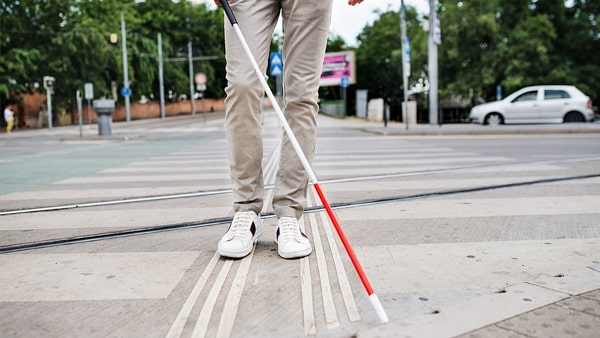
When driving near a blind pedestrian who is carrying a white cane or using a guide dog, you should:
  1. A Take necessary precautions and stop if that is required to avoid danger
  2. B Continue because the pedestrian must wait for all vehicles
  3. C Sound the horn and pass without reducing your margin of safety
  4. D Accelerate to clear the crossing first

Correct answer: A – Take necessary precautions and stop if that is required to avoid danger

Texas law requires a driver approaching such a pedestrian at an intersection or crosswalk to take necessary precautions to avoid injury or danger. The vehicle must come to a full stop if stopping is the only way to avoid that danger. A violation resulting in serious bodily injury or death is punishable by a fine of up to $500 and 30 hours of community service.

Source: Tex. Transp. Code § 552.010(b), (c) – Blind Pedestrians
Question 2

At an intersection without an operating traffic signal, a pedestrian is crossing in an unmarked crosswalk on your half of the roadway. Who must yield?

  1. A The pedestrian, because the crosswalk is not painted
  2. B The pedestrian, unless a WALK signal is displayed
  3. C The driver must stop and yield to the pedestrian
  4. D Neither road user has a right-of-way duty

Correct answer: C – The driver must stop and yield to the pedestrian

Texas law requires the driver to stop and yield when no signal is operating and a pedestrian in a crosswalk is on the driver’s half of the roadway or approaching closely enough to be in danger. The rule applies to marked and unmarked crosswalks at intersections. A pedestrian may not suddenly enter when a vehicle is too close to stop and yield.

Source: Tex. Transp. Code § 552.003(a), (b) – Pedestrian Right-of-Way at Crosswalk, Tex. Transp. Code § 552.005(a) – Crossing at Point Other Than Crosswalk

Question 3

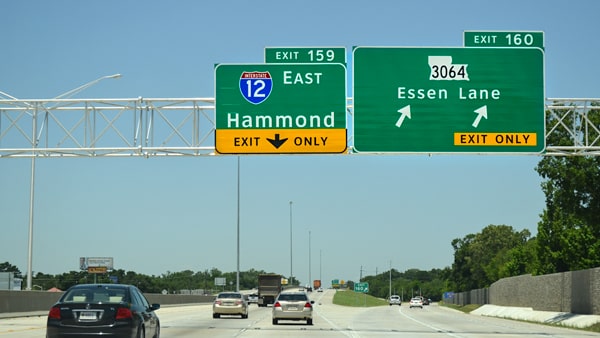
A freeway guide sign above your lane includes a yellow EXIT ONLY panel. If you remain in that lane, you:

If you see this sign above your lane, you:
  1. A May not use the upcoming exit
  2. B May choose either the exit or the through roadway
  3. C Will continue through the interchange in the same lane
  4. D Must leave the freeway at that exit

Correct answer: D – Must leave the freeway at that exit

An EXIT ONLY panel identifies a lane that is dropped at the interchange rather than continuing along the main roadway. A vehicle remaining in that lane will be directed onto the exit. A driver wishing to continue on the freeway must move to a continuing lane, provided the lane change can be completed safely.

Source: Texas Manual on Uniform Traffic Control Devices 2025 § 2E.28 – Signing for Interchange Lane Drops Without an Optional Exit Lane, Tex. Transp. Code § 545.103 – Safely Turning

Question 4

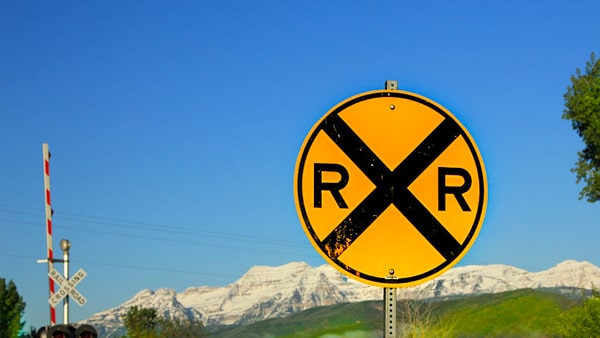
A round yellow sign displaying a black “X” and “RR” warns that you are approaching:

This sign is a warning that you are approaching:
  1. A An ordinary road intersection
  2. B A pedestrian crosswalk
  3. C A railroad or light-rail grade crossing
  4. D A blasting area

Correct answer: C – A railroad or light-rail grade crossing

The round Grade Crossing Advance Warning sign is placed before a railroad or light-rail crossing, subject to limited exceptions in the traffic-control manual. It gives drivers advance notice that tracks and crossing controls are ahead. It does not identify an ordinary intersection, pedestrian crossing, or blasting zone.

Source: Texas Manual on Uniform Traffic Control Devices 2025 § 8B.06 – Grade Crossing Advance Warning Signs (W10-1 through W10-4)

Question 5

When parking downhill on a two-way road without a curb, how should you position the front wheels?

  1. A Turn them left
  2. B Turn them right
  3. C Keep them straight
  4. D Point them toward the centerline

Correct answer: B – Turn them right

The Texas hill-parking diagram instructs drivers to turn the wheels to the right when no curb is present. On a two-way road, this points the front wheels toward the road’s edge. This positioning helps direct the vehicle away from the traveled lanes if it begins to roll.

Source: Texas Driver Handbook — Ch. 7, “Parking on Hills”

Question 6

Which visual habit helps you identify roadway hazards early?

  1. A Watching only the vehicle directly ahead
  2. B Concentrating mainly on the inside mirror
  3. C Scanning well ahead while also noticing nearby conditions
  4. D Using high beams under all conditions

Correct answer: C – Scanning well ahead while also noticing nearby conditions

Safe drivers look well ahead because stopping or changing lanes requires time and distance. The official commercial driving manual recommends looking at least 12 to 15 seconds ahead and shifting attention between near and distant conditions. Focusing on only one vehicle or mirror can prevent you from noticing developing hazards.

Source: Texas Commercial Motor Vehicle Drivers Handbook — § 2.4.1, “Seeing Ahead”