Take the real Texas written test online!

Texas Drivers Ed Practice Test 8

4.8 out of 5 (645 votes)
80% Passing score
20 Questions
4 Mistakes allowed
Texas intersection questions deserve more attention than most people give them. Not because they are wildly complicated, exactly, but because they combine several rules at once — right-of-way, signs, lane position, timing, and that small moment of hesitation when two drivers both think the other one should move first. This Texas drivers ed practice test puts those moments under a brighter light, with 20 multiple-choice questions built around four-way stops, urban intersections, rural crossings, and the kinds of traffic situations that can get a little weird in real driving. The Texas permit test is based on the Texas Driver Handbook published by the Department of Public Safety, so the material is not floating around in mystery-land. DPS expects applicants to understand Texas traffic laws, road signs, safe driving practices, alcohol and drug rules, distracted driving, vehicle equipment, and driver responsibility. Intersections sit right in the middle of all that. A single question might ask about a stop sign, but really it is also testing whether you know who yields, what the other vehicle is likely to do, and whether you noticed the lane setup before answering too quickly. This DPS practice test keeps the focus practical. The questions are written as driving scenarios instead of flat trivia, and the visual learning aids help make the layout clear — which matters, because trying to untangle a busy intersection from words alone can feel like reading furniture assembly instructions with one screw missing. You can take the practice permit test online from a desktop or phone, so it fits into those odd little study windows people actually have. For the Texas Class C knowledge test, the format is multiple choice. The test is commonly described as 30 questions, with 21 correct answers needed to pass, which is 70%. That also means you can miss up to 9 questions, though treating all 9 as a comfort blanket is not exactly a master plan. Road sign questions are included, and depending on your situation, the knowledge exam may be completed through an approved driver education course or taken at a driver license office. Licensing requirements shift by applicant type. Teens must be at least 15 to apply for a learner license and need approved driver education. First-time applicants ages 18 through 24 must complete a 6-hour adult driver education course unless an exception applies. Applicants 25 and older are not required to take driver education, although DPS recommends it for first-time drivers. This Texas driving test practice is built to help you study the rules, but also to slow down and think like a driver before the real test starts.

Skip the DPS written test. No Joke.

Pass guaranteed — or your money back.

Learn More
Promotion
Learn More

Sample Texas Permit Test Questions

Question 1

A red circle and diagonal slash placed over a right-turn arrow means:
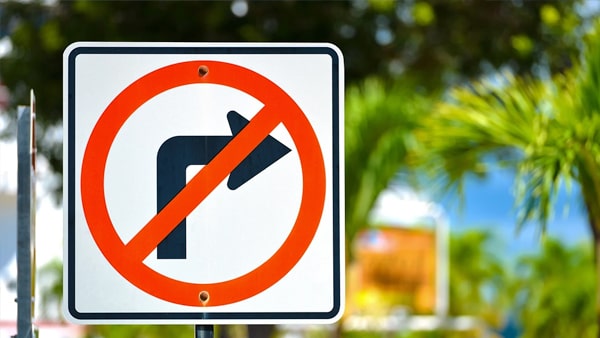
This sign means:
  1. A U-turns are prohibited
  2. B Left turns are prohibited
  3. C Right turns are prohibited
  4. D All turns are prohibited

Correct answer: C – Right turns are prohibited

This is a regulatory sign prohibiting right turns at the location where it is posted. The Texas Driver Handbook explains that regulatory signs tell drivers what they must or must not do. A driver facing this symbol must not make the depicted right turn.

Source: Texas Driver Handbook — Ch. 5, “Regulatory and Warning Signs”
Question 2

Under Texas implied-consent law, chemical analysis of a breath or blood specimen can measure a driver’s:

  1. A Reaction time
  2. B Alcohol concentration
  3. C Visual acuity
  4. D Vehicle-control skill

Correct answer: B – Alcohol concentration

A breath or blood specimen may be analyzed to determine a person’s alcohol concentration. The analysis may also identify the presence of a controlled substance, drug, dangerous drug, or another substance. It does not directly measure reaction time, eyesight, or driving skill.

Source: Tex. Transp. Code § 724.011(a)–(b) – Consent to Taking of Specimen

Question 3

Which situation may keep another driver from seeing you clearly?

Which of the following might cause other drivers not to see you?
  1. A The other vehicle is partly hidden at a blind intersection or alley
  2. B The other vehicle’s windows are covered with frost or ice
  3. C The driver is backing from an obstructed location where only part of the vehicle is visible
  4. D All of the above

Correct answer: D – All of the above

Drivers with blocked vision are a traffic hazard. Frosted or ice-covered windows can limit what a driver sees, and vehicles can be partly concealed at blind intersections or alleys. If you can see only part of a vehicle but cannot see its driver, that driver may also be unable to see you.

Source: Texas Commercial Motor Vehicle Drivers Handbook — § 2.8.3, “Drivers Who Are Hazards”

Question 4

What do flashing hazard lamps on a moving passenger vehicle indicate?

If you see warning hazard lights on a moving passenger vehicle, it means:
  1. A You must turn around immediately
  2. B Every approaching driver must stop on the shoulder
  3. C The vehicle is warning other road users that it may be a hazard
  4. D The vehicle automatically has the right-of-way

Correct answer: C – The vehicle is warning other road users that it may be a hazard

Hazard flashers operate the vehicle’s front turn-signal lights and rear lights to warn others that the vehicle presents a hazard. Notice the warning, remain alert, and respond to the actual traffic conditions around the vehicle.

Source: Texas Driver Handbook — Appendix A, “Glossary of Terms”

Question 5

Which action should you avoid when passing a crash scene?

  1. A Following directions from police or emergency personnel
  2. B Slowing down merely to stare at the scene
  3. C Watching the traffic lane ahead
  4. D Changing lanes when safely directed to do so

Correct answer: B – Slowing down merely to stare at the scene

Crash scenes are hazardous because people may enter the roadway and nearby vehicles may slow or stop suddenly. Passing drivers also tend to look at the crash rather than at traffic. Keep your attention on the road, obey official directions, and do not slow merely to view the scene.

Source: Texas Commercial Motor Vehicle Drivers Handbook — § 2.8.3, “Drivers Who Are Hazards”, Texas Driver Handbook — Ch. 9, “Distracted Driving”

Question 6

Before moving into a passing lane, what should you do?

Before passing another vehicle you should:
  1. A Flash your high beams instead of signaling
  2. B Activate your hazard flashers
  3. C Use the proper turn signal for the lane change
  4. D Sound the horn continuously

Correct answer: C – Use the proper turn signal for the lane change

Texas law requires a driver to signal an intention to change lanes and to make the movement only when it can be completed safely. Use the appropriate turn signal before entering the passing lane. Signal again before returning to the original lane because that movement is also a lane change.

Source: Tex. Transp. Code § 545.103 – Safely Turning, Tex. Transp. Code § 545.104(a) – Signaling Turns; Use of Turn Signals