


Washington DOL Practice Test 3

4.8 out of 5 (2087 votes)
80% Passing score
20 Questions
4 Mistakes allowed
A Washington DOL practice test should do more than toss a few road-sign questions at you. The real Washington knowledge test is a 40-question, multiple-choice exam, and you need at least 32 correct answers to pass. That 80% mark sounds manageable, but it leaves only eight missed questions before you are retaking it, paying whatever your testing location charges, and—well, not exactly moving the process along. This WA driving test practice is built to help you study the rules that actually matter on Washington roads. It draws from the Washington State Driver Guide and covers the familiar permit-test material: signs, pavement markings, right-of-way, pedestrian safety, DUI laws, safe following distance, and the everyday judgment questions that tend to separate guessing from real understanding. Washington also takes distracted driving seriously. Drivers cannot hold a phone while driving, even when stopped at a red light, and teen drivers face even tighter wireless-device rules except for emergency reporting. The full licensing process has a few numbers worth knowing, too. A passing knowledge-test score is valid for two years, while a passing drive-test score is valid for one year. The drive test itself is scored out of 100, with 80 required to pass, and your vehicle needs valid registration, tabs, plates, and proof of insurance. Vision screening is also part of the process, generally using a 20/40 combined-eye standard, with additional review possible if your eyesight falls below state requirements. For younger drivers, Washington’s timeline is more structured. You can get a permit at 15 with approved driver training, or at 15½ without it. Before licensing, teen drivers must hold the permit for six months, complete 40 supervised daylight hours and 10 supervised night hours, and finish approved driver training if they want a license before 18. Once licensed, passenger and late-night driving restrictions apply at first, then loosen after six months and lift automatically at 18. Use this Washington free DMV practice test as a steady check on whether the rules are actually sticking. It is accessible on desktop, tablet, or phone, so you can review in short sessions instead of cramming everything at the last minute. The goal is not just passing the Washington DMV permit test online or in person. It is walking into the DOL test with the details already familiar—and leaving with one less licensing step in your way.
FREE DMV Practice Test App
Study for your Washington permit test or driver’s license with the NextDoorDriving app. 700+ DMV questions and answers, 100% free!
Download on the App Store

Sample Washington Permit Test Questions

Question 1

Which situation is a potential hazard that should draw a driver’s attention?

  1. A. A child moving toward the roadway
  2. B. A nearby driver interacting with passengers
  3. C. Workers or equipment in a work zone
  4. D. All of the above

Correct answer: D. – All of the above

A child entering the roadway is an immediate hazard. Passenger interaction can distract another driver, while workers and equipment require increased attention in work zones. Continually scan for these hazards and be prepared to adjust your speed or position when necessary.

Source: Washington State Driver Guide — § 5.0, “Hazard perception”, Washington State Driver Guide — § 3.4, “Avoiding distracted driving”, Washington State Driver Guide — § 4.12, “Work zone signs”
Question 2

If your engine shuts off while the vehicle is moving, which response follows the state driver guide?

  1. A. Brake as hard as possible and stop in the travel lane
  2. B. Turn off the ignition and continue coasting with traffic
  3. C. Shift into Park before moving toward the roadside
  4. D. Grip the wheel, brake steadily, pull off the road, stop, and then try restarting

Correct answer: D. – Grip the wheel, brake steadily, pull off the road, stop, and then try restarting

Keep a strong grip because the steering wheel may become harder to turn. Use steady brake pressure rather than braking hard, slow down, and pull off the roadway. After stopping, try to restart the engine; if that fails, turn on the hazard lights and call for assistance.

Source: Washington State Driver Guide — Ch. 5, “Power”

Question 3

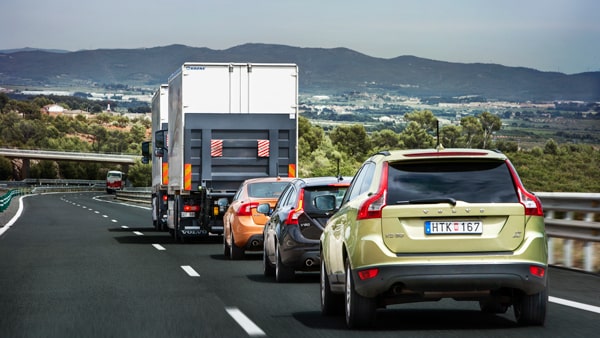
Why is following another vehicle too closely unsafe?

Following closely behind another vehicle:
  1. A. It keeps your vehicle out of the other driver’s blind areas
  2. B. It leaves too little space to respond if the vehicle ahead slows or stops
  3. C. It consistently improves fuel economy
  4. D. It is required during the driving examination

Correct answer: B. – It leaves too little space to respond if the vehicle ahead slows or stops

State law prohibits following another vehicle more closely than is reasonable and prudent for the speed, traffic, and highway conditions. Leaving adequate space gives you time and room to act if the vehicle ahead slows or another hazard develops. Poor conditions require a larger space cushion.

Source: RCW 46.61.145(1) – Following too closely—Vulnerable users of a public way—Fine., Washington State Driver Guide — § 5.2, “Space”

Question 4

A turn signal should be used when:

  1. A. Turning or changing lanes
  2. B. Merging onto or leaving a freeway
  3. C. Moving toward or away from the curb
  4. D. Doing any of the above

Correct answer: D. – Doing any of the above

Washington law requires an appropriate signal before turning or moving right or left on a roadway. Turns, lane changes, freeway merges, exits, and movements into or out of curbside positions involve such changes. Signaling communicates your intended movement, but you must also verify that it can be made safely.

Source: RCW 46.61.305(1) – When signals required—Improper use prohibited., Washington State Driver Guide — § 2.5, “Turn signals”

Question 5

When does Washington law require a slow-moving driver to use an available safe turnout?

  1. A. When the driver wants to make a U-turn
  2. B. When passing is unsafe on a two-lane highway and five or more vehicles have formed behind
  3. C. Whenever one faster vehicle approaches on a multilane highway
  4. D. When the driver wants to park beside the road

Correct answer: B. – When passing is unsafe on a two-lane highway and five or more vehicles have formed behind

A vehicle traveling below the normal traffic flow must turn off when five or more vehicles form a line behind it on a two-lane highway where passing is unsafe. The duty applies only where sufficient space for a safe turnout exists. The purpose is to permit the following vehicles to proceed.

Source: RCW 46.61.427 – Slow-moving vehicle to pull off roadway.

Question 6

While entering a Washington interstate, heavy traffic leaves no safe opening. What are you responsible for doing?

  1. A. Force your vehicle into the smallest available gap
  2. B. Reverse down the entrance ramp
  3. C. Drive along the shoulder until an opening appears
  4. D. Adjust your speed and wait for enough space to merge safely

Correct answer: D. – Adjust your speed and wait for enough space to merge safely

A driver must not move from a lane until the movement can be made safely. Drivers already on the interstate have the right-of-way, and the merging driver should use the ramp, signal, check mirrors, and adjust speed to find adequate space. Do not force other traffic to swerve, slow abruptly, or stop.

Source: RCW 46.61.140(1) – Driving on roadways laned for traffic., Washington State Driver Guide — § 5.3, “Merging”