Washington Road Signs Test 2

4.8 out of 5 (697 votes)
80% Passing score
20 Questions
4 Mistakes allowed
Washington road signs deserve more attention than most drivers give them, especially if you are preparing for the WA DOL knowledge test or renewing your driver’s license and trying to make sure the basics are still sharp. This Washington road signs practice test gives you a focused way to review the signs, signals, and pavement markings covered in the Washington State Driver Guide without turning the whole thing into a long, dramatic study session. Which is good, because nobody needs that. The official Washington driver knowledge test is a multiple-choice test based on the state driver guide. For the standard Class D license, it has 40 questions, and you need 32 correct answers to pass. That is 80%, meaning you can miss up to 8 questions. Road signs are folded into the general knowledge test rather than treated as a separate official road-sign-only exam with its own published passing score. Still, that does not make signs optional background material. Stop, yield, wrong way, do not enter, school zone, railroad crossing, pedestrian crossing, merge, no passing, work zone signs — these are the kinds of signs that tend to show up because they matter on the road, not because someone at the DOL needed filler. This WA DOL practice test includes 20 multiple-choice questions centered on Washington driving signs and road sign recognition. You will see the usual sign colors and shapes, red regulatory signs, yellow warning signs, green guide signs, service and destination signs, lane-use markings, and those symbol-based signs that seem obvious until you have to choose between two answer choices that are just close enough to be irritating. The point is not to memorize signs like flashcards and then forget them five minutes later. It is to get faster and more certain at recognizing what a sign is telling you before you are already halfway through the intersection. The broader Washington knowledge test also covers traffic laws, right-of-way, intersections, stopping, speed, impaired and distracted driving, pedestrians, bicyclists, motorcycles, emergency vehicles, large vehicles, and safe driving decisions in general. So this DMV sign test is one piece of the larger WA driving test practice process, but it is a useful piece. Use it when you want targeted practice, when the full driver guide feels like too much, or when you know, privately, that sign shapes and pavement markings could use another pass.

FREE DMV Practice Test App
Study for your Washington permit test or driver’s license with the NextDoorDriving app. 700+ DMV questions and answers, 100% free!
Download on the App Store

Sample Washington Permit Test Questions

Question 1

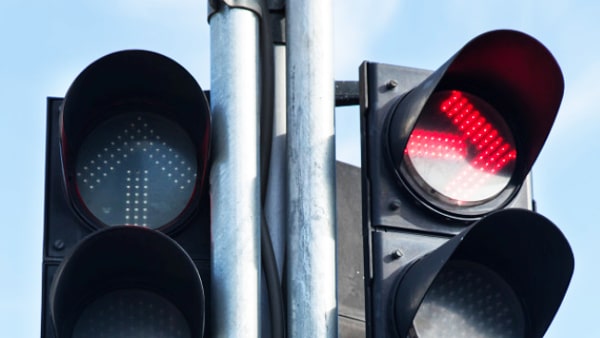
Under Washington law, you face a steady red arrow pointing right and no sign prohibits a right turn on red. What must you do first?

A red arrow pointing to the right on a traffic light means you may:
  1. A Stop completely, then yield as required before turning
  2. B Wait for a green signal in every situation
  3. C Slow down and turn without stopping
  4. D Turn immediately if traffic is waiting behind you

Correct answer: A – Stop completely, then yield as required before turning

A steady red arrow requires a complete stop. After stopping, a right turn may be made unless a posted sign prohibits it. The driver must remain stopped long enough to allow vehicles lawfully within or approaching the intersection and pedestrians lawfully within the intersection to complete their movements.

Source: RCW 46.61.055(3)(c) – Traffic control signal legend.

Question 2

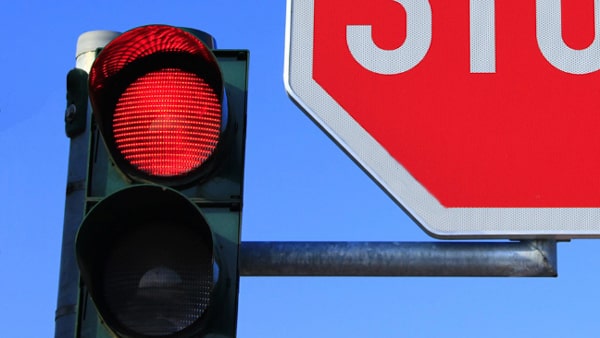
What is the proper response when approaching an intersection controlled by a flashing red signal?

If you are approaching an intersection with a red flashing light, what should you do?
  1. A Continue through without reducing speed
  2. B Slow down and enter without stopping
  3. C Remain stopped until the signal becomes green
  4. D Stop before entering, then proceed according to stop-sign right-of-way rules

Correct answer: D – Stop before entering, then proceed according to stop-sign right-of-way rules

Come to a complete stop at the stop line, crosswalk, or nearest point from which approaching traffic can be seen. You may proceed after the stop when the applicable right-of-way rules allow it. Unlike a steady red signal, a flashing red signal does not require waiting for the light to turn green.

Source: RCW 46.61.065(1)(a) – Flashing signals.

Question 3

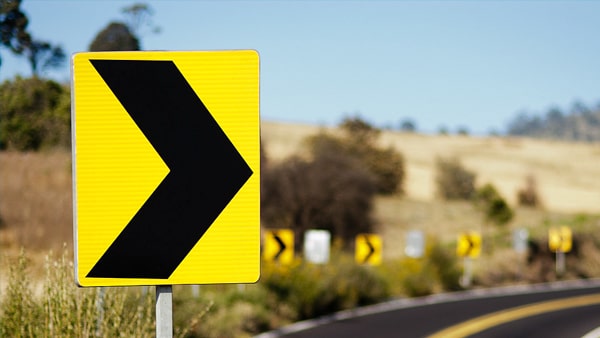
A black-and-yellow chevron sign pointing right emphasizes that:

When you see this sign, it means:
  1. A An object is blocking the roadway
  2. B Traffic will enter from the right
  3. C The roadway changes direction to the right
  4. D A travel lane merges ahead

Correct answer: C – The roadway changes direction to the right

A chevron is a directional warning sign used along a turn or curve. Its point shows the direction in which the roadway alignment changes. It does not indicate merging traffic or identify an object in the roadway, so follow the indicated direction and maintain control through the curve.

Source: Washington State Driver Guide — § 4.12, “Other traffic signs”

Question 4

A two-way road has double solid yellow centerlines. Which movement may still be permitted?

  1. A Turning left into a private driveway when the movement can be made safely
  2. B Using either lane as though the road were one-way
  3. C Driving along the centerlines as a left-turn lane
  4. D Crossing the lines to pass a slow vehicle

Correct answer: A – Turning left into a private driveway when the movement can be made safely

Washington’s no-passing rule prohibits driving left of pavement striping that marks a no-passing zone. The restriction does not apply to a driver turning left into or from an alley, private road, or driveway. The turn must still be signaled and made only when it can be completed with reasonable safety.

Source: RCW 46.61.130(2), (3) – No-passing zones., RCW 46.61.305(1) – When signals required—Improper use prohibited.

Question 5

A steady yellow traffic light warns that which indication will appear immediately afterward?

  1. A Flashing yellow
  2. B Steady green
  3. C Steady red
  4. D Flashing red

Correct answer: C – Steady red

A steady yellow signal warns that the related green movement is ending or that a red indication will appear immediately afterward. The Washington driver guide instructs drivers to slow down and prepare to stop. A driver already within the intersection should continue through without exceeding the posted speed limit.

Source: RCW 46.61.055(2)(a) – Traffic control signal legend., Washington State Driver Guide — § 4.11, “Solid Yellow”

Question 6

Which pavement marking normally identifies the right edge of a roadway?

  1. A A broken white line
  2. B A solid yellow line
  3. C A solid white line
  4. D A broken yellow line

Correct answer: C – A solid white line

A solid white line is used to mark the edge of the road. White lines may also separate traffic moving in the same direction or separate a bicycle lane from other traffic. Yellow centerlines generally separate traffic traveling in opposite directions or identify a no-passing area.

Source: Washington State Driver Guide — § 4.16, “Lanes”