Ohio BMV Practice Test 6

4.8 out of 5 (927 votes)
80% Passing score
20 Questions
4 Mistakes allowed
Turn signals are one of the first things people learn about driving, which is probably why so many people treat them like optional equipment once they are actually on the road. Ohio, inconveniently, still expects you to know how and when to use them. This Ohio BMV practice permit test puts that small little lever under a brighter light, because signaling is one of those topics that seems painfully obvious until the question asks about lane changes, turns, timing, traffic around you, and what other drivers are supposed to understand from your next move. This sixth Ohio BMV practice test gives you 20 multiple-choice questions built around real driving situations, with a special focus on turn signals, intersections, lane changes, and safe communication in traffic. It pulls from the same general world as the Ohio Driver Manual, also called the Digest of Motor Vehicle Laws, which is the official study source for the real knowledge test. And yes, the manual is not exactly beach reading. Still, it is where Ohio lays out the rules on motor vehicle laws, road signs, traffic control devices, rules of the road, safe driving practices, and driver responsibilities — the stuff that shows up when you are trying to qualify for a Temporary Instruction Permit Identification Card, better known as a TIPIC. The real Ohio permit knowledge test has 40 multiple-choice questions. You need a 75% to pass, meaning 30 correct answers out of 40. This Ohio permit practice test is shorter, with 20 questions, so the matching goal is 16 correct answers. It is a smaller bite, basically, but still enough to tell you whether you are reading the road clearly or just coasting on “I’ve ridden in cars before” logic, which, to be fair, is a very common but not especially legal study plan. Some questions may include images, because signs, lane positions, and turning situations are often easier to understand when you can actually see what is happening. After you finish, you will get a summary showing what you missed and the correct answers, which is the part worth slowing down for. Ohio lets applicants take the official knowledge test at age 15 years and 6 months. If you fail, you must wait one day before trying again; in-person testing allows unlimited attempts, one per day, while online testing allows two attempts within six months.

FREE DMV Practice Test App
Study for your Ohio permit test or driver’s license with the NextDoorDriving app. 700+ DMV questions and answers, 100% free!
Download on the App Store

Sample Ohio Permit Test Questions

Question 1

To detect developing hazards, where should a driver search while moving?

  1. A Only along the center of the lane
  2. B Only at the vehicle directly ahead
  3. C Only ahead unless preparing to turn
  4. D Ahead, to the sides, and to the rear

Correct answer: D – Ahead, to the sides, and to the rear

A driver should repeatedly search the entire area around the vehicle. Look well ahead along the planned path, check the sides for traffic that may cross it, and use mirrors to monitor traffic behind. Looking ahead gives you more time to adjust speed or roadway position when a problem develops.

Source: Ohio Driver Manual — § 8, “Visual Search”

Question 2

You are traveling 55 mph on a two-lane highway. Before passing another vehicle, which condition must you verify?

  1. A The vehicle ahead has slowed, even though oncoming traffic is near
  2. B The left side is visible and clear far enough to complete the pass safely
  3. C A solid yellow center line has begun on your side

Correct answer: B – The left side is visible and clear far enough to complete the pass safely

Ohio law requires the left side of the roadway to be clearly visible and free of oncoming traffic for enough distance to complete the pass. The maneuver cannot interfere with approaching or overtaken traffic. If the opposing lane is used, you must return to an authorized lane before coming within 200 feet of an approaching vehicle.

Source: Ohio Rev. Code § 4511.29(A) – Driving to left of center of roadway in overtaking and passing traffic proceeding in same direction

Question 3

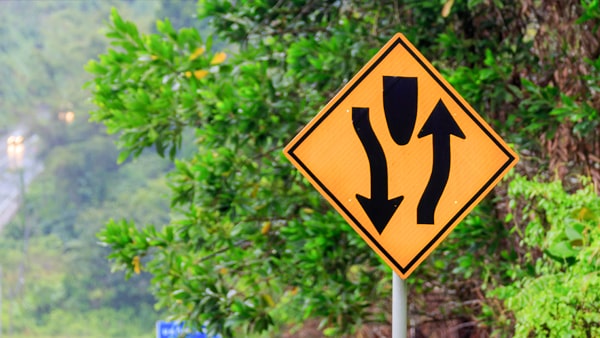
A yellow warning sign showing opposing traffic arrows separating around a median means:

This sign means:
  1. A The divided highway ends
  2. B A one-way street begins
  3. C A one-way street ends
  4. D A divided highway begins

Correct answer: D – A divided highway begins

This is the W6-1 Divided Highway warning sign. It is placed before a section where opposing traffic flows become separated by a median or another physical barrier. The W6-2 sign uses a different symbol to warn that a divided section is ending.

Source: Ohio Manual of Uniform Traffic Control Devices (11th ed.) — Part 2, Ch. 2C, §§ 2C.20–2C.21, “Divided Highway Sign (W6-1)” and “Divided Highway Ends Sign (W6-2)”

Question 4

When may an occupant open a parallel-parked vehicle’s door on the traffic side?

  1. A Whenever it is daylight
  2. B When a nearby traffic light turns red
  3. C Only when it is reasonably safe and will not interfere with moving traffic
  4. D After the hazard lights are activated

Correct answer: C – Only when it is reasonably safe and will not interfere with moving traffic

Ohio law prohibits opening a vehicle door on the side available to moving traffic until it is reasonably safe. The door must not interfere with the movement of other traffic. It also may not remain open longer than necessary to load or unload passengers.

Source: Ohio Rev. Code § 4511.70(C) – Obstructing view and control of driver - opening door into moving traffic

Question 5

The Ohio Driver Manual’s four-second method measures the space _________ your vehicle.

  1. A To the sides of
  2. B Ahead of
  3. C Behind
  4. D All around

Correct answer: B – Ahead of

The four-second method measures following distance between your vehicle and the vehicle ahead. Begin counting when the rear of that vehicle passes a fixed point, such as a sign or pole. If you reach the same point before four seconds have elapsed, increase your following distance.

Source: Ohio Driver Manual — § 8, “Space Management,” “Space to the Front”

Question 6

When is a driver prohibited from entering an intersection, even with a signal to proceed?

  1. A When there is not enough room beyond it to clear without obstructing others
  2. B Whenever the signal is steady yellow
  3. C When traffic on the cross street is stopped
  4. D When turning right from the rightmost lane

Correct answer: A – When there is not enough room beyond it to clear without obstructing others

Ohio law requires sufficient space on the far side before a driver enters an intersection. Your vehicle must be able to clear the intersection without obstructing vehicles or pedestrians. This requirement applies regardless of a highway traffic signal indicating that you may proceed.

Source: Ohio Rev. Code § 4511.712(A) – Obstructing intersection