Washington DC Learners Permit Practice Test 9

4.8 out of 5 (107 votes)
80% Passing score
20 Questions
4 Mistakes allowed
Before you worry about parallel parking on a narrow DC block or figuring out which lane actually continues through the circle, there is a quieter rule you need to know cold: what to do when a school bus stops. Do you stop only if you are behind the bus? What if the road is divided? What if a child is already across the street, mostly, but not quite? That is the kind of detail this DC learners permit practice test is built around, and it is worth taking seriously. This Washington DC DMV learners practice test includes 20 questions focused on school bus safety, stopping requirements, yielding, and the judgment drivers need when children are boarding, exiting, or crossing near a bus. You need 16 correct answers to pass, but the test is not timed, which is a small mercy because some of these rules deserve more than a rushed guess. Use the hints when a question gets oddly specific. Read the explanation when you miss one. That is usually where the rule finally sticks, in that slightly irritating “oh, right” moment after choosing wrong. And then there is the actual DC DMV process, because the practice test is only one part of getting licensed. A learner permit costs $20. The knowledge test costs $10 at a DC DMV service center, $39.95 at a Test Proctoring Center, or $49.95 for the virtual knowledge test, and the fee applies whether you pass or fail. Service center knowledge testing is first-come, first-served, while virtual testing and Test Proctoring Center testing require an appointment. If you pass the virtual knowledge test, you still have to visit a DC DMV service center within 14 business days with the required eligibility documents, or DC DMV will not honor the result. Retakes are not instant, either. After a failed knowledge test, you must wait 3 full calendar days. After six failed attempts within 12 months, the seventh attempt has to wait until 12 months after the first failed test. Cheating, using a smart device, checking study materials, or talking during testing can mean a failed result and a 60-day retest ban.  But before you get to all that, let's get back to the school bus rules. One thing at a time, right?
FREE DMV Practice Test App
Study for your Washington DC permit test or driver’s license with the NextDoorDriving app. 700+ DMV questions and answers, 100% free!
Download on the App Store

Sample Washington DC Permit Test Questions

Question 1

At an unsignalized intersection, a pedestrian is crossing within an unmarked crosswalk and is in your lane. What must you do?

  1. A Continue because no crosswalk lines are painted
  2. B Stop and remain stopped to allow the pedestrian to cross
  3. C Slow only if the pedestrian is a child
  4. D Sound the horn and proceed around the pedestrian

Correct answer: B – Stop and remain stopped to allow the pedestrian to cross

District law protects pedestrians in both marked crosswalks and unmarked crosswalks at intersections. A driver must stop and remain stopped when the pedestrian is in the driver's lane or within one lane approaching it. The absence of painted crosswalk lines does not remove this duty.

Source: D.C. Code § 50-2201.28(a) – Right-of-Way at Crosswalks
Question 2

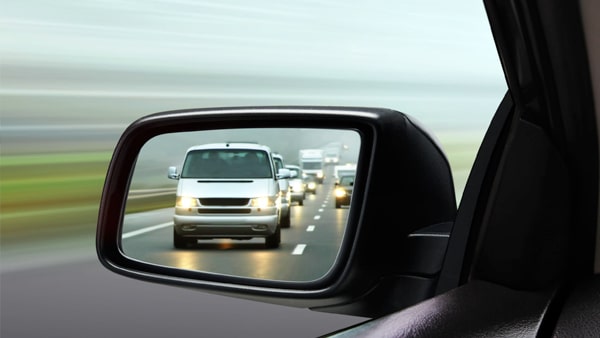
Why should you check your blind spots carefully for bicyclists before changing lanes?

  1. A Bicyclists always have priority over every other road user
  2. B A bicycle may be beside your vehicle but outside your mirrors' view
  3. C Bicyclists are required to travel against traffic
  4. D Bicyclists are exempt from traffic-control devices

Correct answer: B – A bicycle may be beside your vehicle but outside your mirrors' view

Bicycles are treated as vehicles, but their smaller size can make them difficult to notice beside a car. Mirrors do not provide a complete view of adjacent areas. Before changing lanes or otherwise moving sideways, check the mirrors and glance over the appropriate shoulder to verify that the blind spot is clear.

Source: DC DMV Driver Manual — Driving Rules, “Changing Lanes”, DC DMV Driver Manual — Traffic Rules, “Sharing the Road with Bicycles”

Question 3

Another driver begins passing your vehicle on the left. What are you required to do?

The car behind you begins to pass you. You should:
  1. A Increase speed to shorten the passing maneuver
  2. B Move toward the center of the roadway
  3. C Give way to the right and do not increase your speed
  4. D Stop in your traffic lane

Correct answer: C – Give way to the right and do not increase your speed

When properly signaled by an overtaking vehicle, the driver being passed must give way to the right and must not increase speed until completely passed. This District rule helps provide room for the passing vehicle. It does not require the overtaken driver to stop or leave the roadway.

Source: 18 DCMR § 2202.4 – Overtaking and Passing

Question 4

What does a posted 35 mph speed-limit sign establish?

  1. A A speed that may be exceeded to match traffic flow
  2. B The maximum legal speed, although conditions may require a lower speed
  3. C A limit that applies only when police are present

Correct answer: B – The maximum legal speed, although conditions may require a lower speed

A posted speed-limit sign states the maximum legal speed for that section of roadway. Drivers may not exceed it merely because surrounding traffic is moving faster. District law also requires a speed that is reasonable for existing road, weather, visibility, and traffic conditions, which may be lower than the posted limit.

Source: D.C. Code § 50-2201.04 – Speeding and Reckless Driving, DC DMV Driver Manual — Traffic Rules, “Speed Restrictions”

Question 5

A driver extends the left hand and arm upward. What maneuver is being signaled?

  1. A A left turn
  2. B A right turn
  3. C Slowing or stopping
  4. D Continuing straight

Correct answer: B – A right turn

An upward-pointing left hand and arm is the standard hand signal for a right turn. A horizontally extended left arm signals a left turn, while a downward-pointing left arm signals slowing or stopping. Watch for these signals from drivers and bicyclists whose vehicles may not display conventional turn signals.

Source: DC DMV Driver Manual — Signals, Signs and Markings, “Turn Signals, Emergency Signals and Hand Signals”

Question 6

Which instruction takes priority over a traffic signal or sign?

Which of the following must you obey over the other three?
  1. A A steady red traffic light
  2. B A lawful direction from a police officer
  3. C A stop sign
  4. D A flashing red traffic signal

Correct answer: B – A lawful direction from a police officer

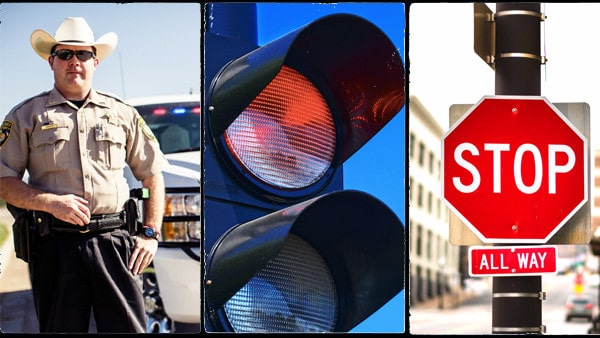
Drivers must comply with the lawful directions of police officers and other persons legally authorized to direct traffic. District regulations also require obedience to traffic-control devices unless a police officer directs otherwise. For example, an officer may require you to stop at a green light or proceed despite an otherwise controlling signal.

Source: 18 DCMR § 2000.2, .4 – Obedience to Traffic Regulations