


Washington DC DMV Sign Test 3

4.9 out of 5 (94 votes)
80% Passing score
20 Questions
4 Mistakes allowed
In DC, you do not always get a polite, unobstructed view of a road sign. Sometimes there is a bus in the way. Sometimes the lane bends, the light changes, and the sign is half-hidden behind a delivery truck that has decided, for reasons known only to itself, that the curb lane is a personal storage unit. Still, you are expected to know what the sign means. That is the point of this Washington DC DMV signs practice test: to make sign recognition quicker, sharper, and less dependent on perfect driving conditions. This DC road signs test gives you 20 questions focused on road sign shapes, meanings, and functions. That matters because the shape is often the first thing you register. An octagon is not asking for your opinion; it means stop. A triangle tells you to yield. Rectangular signs usually handle rules, limits, directions, and other instructions that sound basic until you are reading them while moving through Foggy Bottom, Dupont Circle, Georgetown, or one of those intersections where five things seem to be happening at once. And yes, the words on the sign matter too, obviously, but the shape gives you the first warning. After you finish this DMV sign test, you can review missed answers and read the explanations. Passing is 16 out of 20, but the better target is being able to spot the sign, understand it, and react before DC traffic starts making the lesson louder. For younger drivers, this DC learners permit practice test also sits inside a larger licensing process. The minimum age for a DC DMV learner permit is 16, and applicants need to pass the vision screening and knowledge test. Drivers under 21 are placed in DC’s GRAD program, beginning with the supervised learner phase. During that learner permit stage, driving is limited to 6:00 a.m. through 9:00 p.m., with practice supervised by a qualified licensed driver. To move on to a provisional license, a driver must hold the permit for at least 6 months, complete 40 hours of supervised practice, avoid point-assessable offenses, and pass the road skills test. It is a process. A fairly specific one. Adults age 21 and older are not part of GRAD, so they skip the 6-month permit holding period, provisional license stage, and supervised-practice certification requirements. They still need the required documents, vision screening, knowledge test, learner permit if they are not already licensed, and the road skills test. But first, it's about getting the permit. And that starts with passing the test.
FREE DMV Practice Test App
Study for your Washington DC permit test or driver’s license with the NextDoorDriving app. 700+ DMV questions and answers, 100% free!
Download on the App Store

Sample Washington DC Permit Test Questions

Question 1

A solid yellow line and a broken yellow line separate opposing traffic. If the broken line is beside your lane, when may you pass?

When the road is marked with a solid yellow line and a broken yellow line on your side you may pass:
  1. A Only during an emergency
  2. B Only on an expressway
  3. C When the roadway ahead is clear for a safe pass
  4. D Only while crossing an intersection

Correct answer: C – When the roadway ahead is clear for a safe pass

In the District, the broken yellow line beside your lane indicates that crossing the center marking to pass may be permitted. Before passing, the left side must be clearly visible and free of oncoming traffic for enough distance to complete the maneuver safely. The vehicle must return to the right before coming within 100 feet of approaching traffic.

Source: 18 DCMR § 2100.2 – Standards for Placement of Traffic Control Devices, Signs, and Pavement Markings, 18 DCMR § 2202.7-.8 – Overtaking and Passing, Manual on Uniform Traffic Control Devices, 11th ed. — § 3B.01, “Yellow Center Line Pavement Markings”
Question 2

Which color is used for longitudinal lines separating traffic moving in opposite directions?

  1. A White
  2. B Red
  3. C Black
  4. D Yellow

Correct answer: D – Yellow

Yellow longitudinal markings separate traffic traveling in opposite directions. Yellow is also used along the left-hand edge of divided highways and one-way roadways and around two-way left-turn lanes. White longitudinal markings normally separate traffic moving in the same direction or mark the roadway’s right edge.

Source: 18 DCMR § 2100.2 – Standards for Placement of Traffic Control Devices, Signs, and Pavement Markings, Manual on Uniform Traffic Control Devices, 11th ed. — § 3A.03, “Colors”

Question 3

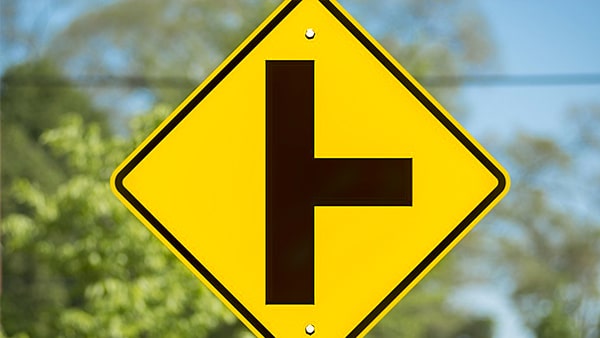
A yellow diamond sign shows a short road joining the main roadway from the right. What does it warn of?

This sign means:
  1. A Traffic must turn right
  2. B A side road enters ahead
  3. C Traffic must continue straight
  4. D Right turns are prohibited

Correct answer: B – A side road enters ahead

This warning sign indicates that a side road enters from the right ahead. Watch for vehicles entering, leaving, or crossing your path near the junction. Because it is a warning sign, it alerts you to the road configuration rather than requiring a particular turn.

Source: DC DMV Automobile Driver Manual — Signals, Signs and Markings, “Warning Signs”, 18 DCMR § 2100.2 – Standards for Placement of Traffic Control Devices, Signs, and Pavement Markings

Question 4

When may a driver cross double solid yellow centerlines?

  1. A To pass a slower vehicle
  2. B Only during daylight hours
  3. C Whenever opposing traffic is absent
  4. D To turn left into or from an alley, private road, or driveway

Correct answer: D – To turn left into or from an alley, private road, or driveway

Double solid yellow centerlines prohibit passing in both directions. In the District of Columbia, a driver may cross them to make a left turn into or from an alley, private road, or driveway. Any turn or movement from a direct course must be made only when it is reasonably safe.

Source: DC DMV Automobile Driver Manual — Signals, Signs and Markings, “Pavement Markings”, 18 DCMR § 2204.2 – Turning Requirements and Restrictions

Question 5

Which color combination is normally used for highway guide signs?

  1. A Black lettering on orange
  2. B White lettering on green
  3. C Black lettering on yellow
  4. D White lettering on red

Correct answer: B – White lettering on green

Highway guide signs generally display white lettering and symbols on a green background. They provide information about routes, destinations, directions, distances, and exits. Their color distinguishes them from yellow warning signs and white regulatory signs.

Source: DC DMV Automobile Driver Manual — Signals, Signs and Markings, “Guide and Information Signs”

Question 6

After stopping and before entering an intersection, where should you look for conflicting traffic?

  1. A Ahead and to the left
  2. B Only to the left and right
  3. C To the left, right, and ahead
  4. D Ahead and to the right

Correct answer: C – To the left, right, and ahead

A complete stop does not establish that the intersection is clear. Look left, right, and ahead for approaching vehicles, pedestrians, bicyclists, and other hazards. After stopping, you must yield to traffic in or close enough to the intersection to present an immediate hazard and must also yield to pedestrians.

Source: 18 DCMR § 2208.3–.4 – Right-of-Way: Intersections, DC DMV Automobile Driver Manual — Driving Rules, “Intersections”