


Washington DC DMV Sign Test 4

4.8 out of 5 (94 votes)
80% Passing score
20 Questions
4 Mistakes allowed
In DC, a road sign is rarely sitting there politely by itself, waiting for you to notice it. It is usually competing with a bus edging over, a cyclist in your mirror, a confusing lane shift, and someone half-committed to a turn they should have planned two blocks ago. Still, you are expected to know what the sign means. That is the whole deal. This DC road sign test is built around that reality: quick recognition, clear understanding, and fewer shaky guesses when the real DMV knowledge test is in front of you. This DC DMV practice test gives you 20 multiple-choice questions focused on road signs, sign shapes, colors, and the basic signals drivers are supposed to understand before they start making decisions in traffic. The questions are based on the official DC DMV Automobile Driver Manual, which is the source DC uses for its knowledge exam. And, slightly inconvenient but important, DC does not treat road signs as some cute little side topic. They are part of the broader knowledge test, mixed in with traffic laws, pavement markings, parking rules, safety rules, and general driver responsibility. The real test changes a bit depending on your age. GRAD applicants, ages 16 through 20, answer 30 questions and need 24 correct to pass. Adults 21 and older answer 25 questions and need 20 correct. So either way, you are aiming for 80%. That sounds manageable, and it is, but only if the material is familiar enough that you are not burning time debating whether a sign is regulatory, warning, or just “probably telling me something important.” This DMV signs practice test keeps the pressure low on purpose. You can take it on a phone, tablet, or desktop, and the instant feedback makes missed answers useful instead of just mildly embarrassing. It is a good fit for learner permit prep, renewal review, or anyone who has driven past the same sign for years and suddenly realized they only sort of know what it means. A little practice here can make the official test feel less like a trap and more like what it actually is: a check that you understand the signs keeping DC traffic from becoming even more chaotic than it already is.
FREE DMV Practice Test App
Study for your Washington DC permit test or driver’s license with the NextDoorDriving app. 700+ DMV questions and answers, 100% free!
Download on the App Store

Sample Washington DC Permit Test Questions

Question 1

What does a yellow pennant-shaped sign posted on the left side of the road indicate?
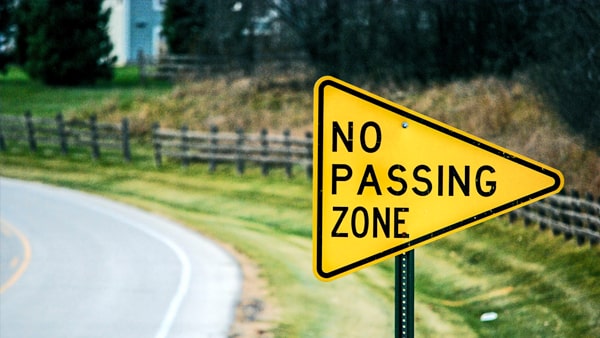
The sign with this shape and color is a _____________ sign.
  1. A The beginning of a no-passing zone
  2. B Traffic is traveling the wrong way
  3. C A railroad crossing is ahead
  4. D A complete stop is required

Correct answer: A – The beginning of a no-passing zone

A yellow pennant-shaped sign marks the beginning of a no-passing zone. It is normally placed on the left side of the roadway so it faces approaching drivers. The yellow-and-black coloring identifies it as a warning sign rather than a stop or wrong-way regulation.

Source: DC DMV Automobile Driver Manual — Signals, Signs and Markings, “Identifying Signs by Colors and Shapes”, DC DMV Automobile Driver Manual — Signals, Signs and Markings, “Warning Signs”
Question 2

Which pavement marking directs drivers to lanes designated for particular turns?

  1. A Flashing red signals
  2. B Flashing yellow signals
  3. C White edge lines
  4. D White directional arrows within the lanes

Correct answer: D – White directional arrows within the lanes

White directional arrows painted in travel lanes show the movement assigned to each lane, such as straight, left, or right. Drivers preparing to turn must follow the directions provided by applicable signs, signals, and pavement markings. Select the proper lane before reaching the intersection.

Source: DC DMV Automobile Driver Manual — Signals, Signs and Markings, “Pavement Markings”, 18 DCMR § 2203.2 – Turning at Intersections

Question 3

Your signal turns green, but vehicles are still occupying the intersection. What should you do?

  1. A Wait until the vehicles clear and you can cross completely
  2. B Drive around the vehicles if space appears available
  3. C Enter the intersection and wait there
  4. D Honk and proceed into the intersection

Correct answer: A – Wait until the vehicles clear and you can cross completely

In the District of Columbia, traffic facing green must yield to vehicles and pedestrians lawfully within the intersection. A driver also may not enter unless the vehicle can completely clear the intersection without obstructing other traffic or pedestrians. Wait behind the intersection until enough space is available.

Source: 18 DCMR § 2103.3(b) – Traffic Control Signals: Vehicles, 18 DCMR § 2201.11 – Driving on the Right Side of the Roadway: Proper Use of the Roadway

Question 4

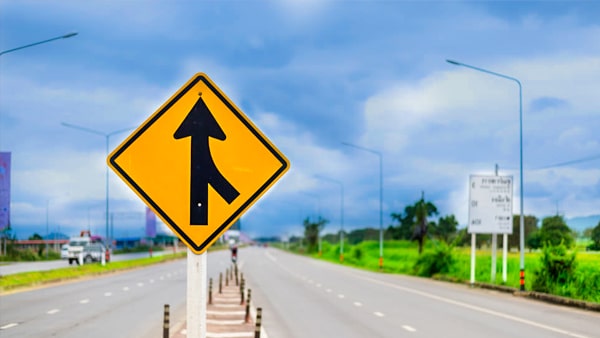
A yellow diamond sign shows another traffic path joining your lane from the right. What does it mean?

This sign means:
  1. A Two-way traffic begins ahead
  2. B The roadway narrows from both sides
  3. C Traffic will merge with your lane ahead
  4. D A divided highway begins

Correct answer: C – Traffic will merge with your lane ahead

The sign warns that traffic from another roadway will merge with the traffic stream ahead. Check the surrounding lanes and be alert for vehicles entering near the merge point. The sign is a warning of the upcoming traffic pattern, not a turn requirement.

Source: DC DMV Automobile Driver Manual — Signals, Signs and Markings, “Warning Signs”, 18 DCMR § 2100.2 – Standards for Placement of Traffic Control Devices, Signs, and Pavement Markings

Question 5

What must a driver do when approaching a steady yellow traffic signal?

  1. A Accelerate through the intersection
  2. B Yield without stopping
  3. C Prepare to stop and stop unless it cannot be done safely
  4. D Stop immediately, even if already in the intersection

Correct answer: C – Prepare to stop and stop unless it cannot be done safely

A steady yellow signal warns that the related green indication is ending or that red will follow. District regulations require traffic to stop before entering the nearest crosswalk unless the vehicle is too close to stop safely. Do not accelerate merely to enter before the light changes.

Source: 18 DCMR § 2103.5 – Traffic Control Signals: Vehicles

Question 6

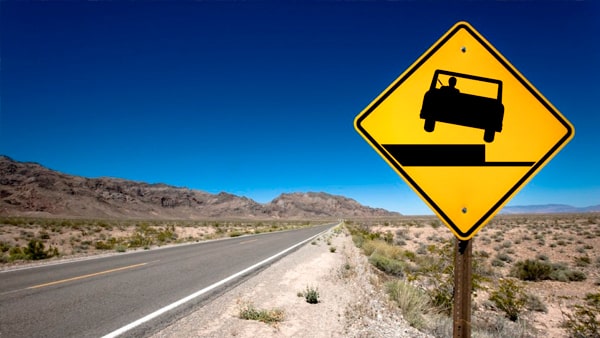
A yellow warning sign shows the pavement edge dropping to a lower shoulder. What hazard does it identify?

What should you be most concerned about when you see this sign?
  1. A Misaligned headlights on uneven pavement
  2. B An automatic tire-damage area
  3. C Standing water on every shoulder
  4. D Possible loss of control if the vehicle leaves the pavement

Correct answer: D – Possible loss of control if the vehicle leaves the pavement

The shoulder drop-off sign warns that the shoulder is lower than the adjoining roadway. If a tire leaves the pavement, the height difference can make vehicle control and reentry more difficult. Reduce speed, maintain your lane position, and avoid an abrupt steering correction.

Source: DC DMV Automobile Driver Manual — Signals, Signs and Markings, “Warning Signs”