


Washington DC Road Signs Test 2

5 out of 5 (93 votes)
80% Passing score
20 Questions
4 Mistakes allowed
DC has a special talent for hiding the one sign you actually need behind a bus, a delivery truck, a tree branch, or some perfectly timed chaos. And yet, unfair as it feels in the moment, you are still expected to know what that sign means and obey it. This DC road signs practice test can't tell you where every sign will be, but it can help make sure you recognize one when you see it.   Road sign questions are part of the official DC DMV knowledge test, worked in with traffic laws, driving safety rules, signals, pavement markings, parking rules, and the broader “please do not make driving worse for everyone” category of driver responsibility. So this DC road signs test gives you a focused way to study one part of the exam before you see the full DMV knowledge test. The practice test includes 20 multiple-choice questions covering sign meanings, shapes, colors, regulatory signs, warning signs, traffic signals, and pavement markings. Some of it is straightforward, until it suddenly is not. Red signs usually mean stop, yield, or do not do the thing you were maybe about to do. Yellow signs warn you about what is coming. Green signs point you where to go. White regulatory signs tell you the rules, often in the plainest possible language, which somehow makes them easier to underestimate. The trick is knowing the sign well enough that you do not have to debate it while traffic is already moving around you. For the official DC DMV knowledge test, GRAD applicants ages 16 through 20 answer 30 questions and need 24 correct to pass. Adults age 21 and older answer 25 questions and need 20 correct. Both versions require an 80% passing score. The GRAD or learner permit knowledge test has a 75-minute limit, while the standard non-commercial knowledge test has a 60-minute limit. If you fail, DC DMV requires a wait of 3 full calendar days before you can test again. Which is not catastrophic, obviously, but it is a fairly irritating way to discover you should have spent a little more time on signs.  To avoid pesky delays, practice makes perfect. So get to it.
FREE DMV Practice Test App
Study for your Washington DC permit test or driver’s license with the NextDoorDriving app. 700+ DMV questions and answers, 100% free!
Download on the App Store

Sample Washington DC Permit Test Questions

Question 1

When may you cross a single solid white line separating lanes?

  1. A Whenever the next lane is moving faster
  2. B When necessary and the movement can be made with reasonable safety
  3. C Only when entering a driveway
  4. D Only when making a U-turn

Correct answer: B – When necessary and the movement can be made with reasonable safety

In the District, a solid white lane line indicates that crossing is discouraged. If crossing becomes necessary, first confirm that the movement can be made with reasonable safety and obey any signs restricting lane changes. Double solid white lines or posted lane-use restrictions may prohibit a movement that a single solid line alone does not prohibit.

Source: 18 DCMR § 2100.2 – Standards for Placement of Traffic Control Devices, Signs, and Pavement Markings, 18 DCMR § 2204.2 – Turning Requirements and Restrictions, Manual on Uniform Traffic Control Devices, 11th ed. — § 3B.06, “White Lane Line Pavement Markings”

Question 2

Which color separates adjacent traffic lanes moving in the same direction?

  1. A Yellow
  2. B White
  3. C Red
  4. D Black

Correct answer: B – White

White longitudinal markings separate traffic streams traveling in the same direction. A broken white line is generally used where careful crossing is permitted, while a solid white line indicates that crossing is discouraged. White is also used to mark the right-hand edge of a roadway.

Source: 18 DCMR § 2100.2 – Standards for Placement of Traffic Control Devices, Signs, and Pavement Markings, Manual on Uniform Traffic Control Devices, 11th ed. — § 3A.03, “Colors”, Manual on Uniform Traffic Control Devices, 11th ed. — § 3B.06, “White Lane Line Pavement Markings”

Question 3

You must not cross a broken white or yellow line when:

  1. A The movement cannot be made with reasonable safety
  2. B Turning left into a driveway
  3. C Going around a disabled vehicle when safe
  4. D Passing on the right where it is otherwise permitted

Correct answer: A – The movement cannot be made with reasonable safety

A broken line may permit a lane change or passing maneuver, but it does not guarantee that the movement is safe. Before moving from a direct course, a driver must confirm that the maneuver can be made with reasonable safety. When passing to the left, there also must be enough clear roadway to complete the maneuver without interfering with other traffic.

Source: 18 DCMR § 2204.2 – Turning Requirements and Restrictions, 18 DCMR § 2202.7 – Overtaking and Passing

Question 4

What does a flashing yellow traffic signal require?

  1. A Continue at the same speed
  2. B Come to a complete stop
  3. C Proceed through only with caution
  4. D Wait until a steady green signal appears

Correct answer: C – Proceed through only with caution

In the District, a flashing yellow signal permits drivers to continue through the intersection or past the signal only with caution. It does not impose the same complete-stop requirement as a flashing red signal. Remain attentive to traffic controls and roadway users while proceeding.

Source: 18 DCMR § 2104.3 – Flashing Red and Yellow Signals: Vehicles

Question 5

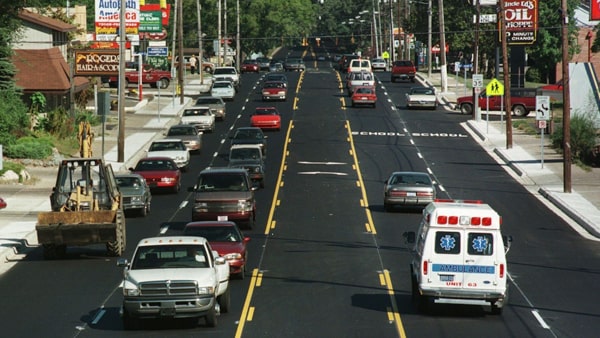
A center lane marked for use by traffic from both directions is intended for:

The center lane in the illustration is used for:
  1. A Ordinary through travel
  2. B Left turns only
  3. C Passing slower vehicles
  4. D Emergency vehicles only

Correct answer: B – Left turns only

Where District signs and pavement markings identify a center lane for two-way left turns, vehicles using that lane must make a left turn. The lane is not an ordinary travel lane and may not be used for overtaking or passing. Drivers must also follow any arrows or signs directing how the lane is used.

Source: 18 DCMR § 4016.7 – “Left Turn Only” Requirements, 18 DCMR § 2203.2 – Turning at Intersections

Question 6

When two yellow center lines are present, passing may be permitted when the line nearest your lane is:

You may cross a double line to pass another vehicle if the line on your side is:
  1. A Solid yellow
  2. B Part of a double solid line
  3. C Broken yellow
  4. D Solid white

Correct answer: C – Broken yellow

A broken yellow line on your side of the center marking indicates that passing with care may be permitted. The marking does not guarantee a safe opportunity to pass. The left side must be clearly visible and free of oncoming traffic for enough distance to complete the maneuver safely.

Source: 18 DCMR § 2100.2 – Standards for Placement of Traffic Control Devices, Signs, and Pavement Markings, 18 DCMR § 2202.7 – Overtaking and Passing, Manual on Uniform Traffic Control Devices, 11th ed. — § 3B.01, “Yellow Center Line Pavement Markings”