


Washington DC DMV Test Evaluation

4.8 out of 5 (487 votes)
80% Passing score
10 Questions
2 Mistakes allowed
Some DMV tests feel like they were built in a conference room with bad lighting and one extremely patient person arguing about pavement markings. The Washington DC DMV permit test has that same personality: practical, rule-heavy, and very interested in whether you understand the small stuff before anyone hands you a learner permit. This 10-question initial evaluation test is a cleaner way to step into that world without immediately committing to the full-length version. The DC DMV bases its knowledge exam on the official Automobile Driver Manual. Our questions are randomly selected and cover the same kind of material DC DMV expects drivers to know: traffic laws, road signs, right-of-way rules, signals, pavement markings, parking rules, safe driving habits, and the basic responsibilities that come with operating a vehicle in the District. You need 8 correct answers out of 10 to pass this DC DMV practice test. That 80% score is not just a tidy number, either. The real DC DMV knowledge test also uses an 80% passing mark, though the official test is longer. GRAD applicants ages 16 through 20 get 30 questions and need 24 correct, while adult applicants age 21 and older get 25 questions and need 20 correct. So, yes, this Washington DC permit practice test is brief. That does not make it decorative. It gives you a quick, fairly honest read on whether you are recognizing the rules or just recognizing words you have seen before, which is a different thing and, unfortunately, the DMV tends to notice. One detail worth keeping in your back pocket: if you fail the official knowledge test, DC requires a wait of 3 full calendar days before you can retest. The good news is this test gives you some help as you go. Hints are available when a question starts to feel slippery, and missed answers come with explanations so the rule has a chance to stick instead of disappearing into the usual fog of “I’ll remember that later.” Some questions include images, which helps with signs, lane markings, and traffic situations that are much easier to understand when you can actually see the setup. Use this learners permit practice test as your first pass. If it goes well, good. Then keep going through the other DMV permit test practice sets, because the real Washington DC DMV written test rewards familiarity more than optimism.
FREE DMV Practice Test App
Study for your Washington DC permit test or driver’s license with the NextDoorDriving app. 700+ DMV questions and answers, 100% free!
Download on the App Store

Sample Washington DC Permit Test Questions

Question 1

Several vehicles far ahead suddenly show brake lights. What should you do?

You should usually drive slower when:
  1. A Accelerate before traffic slows
  2. B Watch only the vehicle directly ahead
  3. C Reduce speed and prepare to stop
  4. D Move onto the shoulder to pass

Correct answer: C – Reduce speed and prepare to stop

Brake lights on several vehicles ahead signal that traffic may be slowing or stopping. Ease off the accelerator, increase your readiness to brake, and preserve enough following distance for a controlled stop. Looking beyond the nearest vehicle helps you respond earlier and avoid abrupt maneuvers.

Source: DC DMV Automobile Driver Manual — “Driving in Heavy Traffic”, DC Commercial Driver License Manual — § 2.4.1, “Seeing Ahead”
Question 2

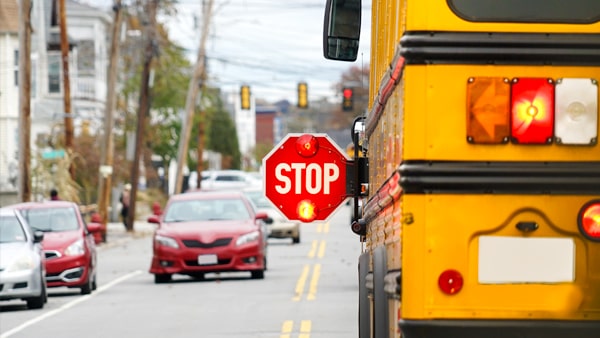
On an undivided District street, what must you do when approaching a stopped school bus with flashing warning lights or an extended stop arm?

What does it mean when a school bus is stopped and its red lights are flashing?
  1. A Pass if no child is visible
  2. B Stop at least 15 feet away and remain stopped
  3. C Pass when approaching the front of the bus
  4. D Proceed slowly if the bus driver signals

Correct answer: B – Stop at least 15 feet away and remain stopped

Drivers approaching from either direction must stop at least 15 feet from the bus. They may not proceed until the warning lights have stopped flashing and the stop arm is no longer extended. The opposite-direction requirement does not apply when the bus is across a street divided by a median strip.

Source: 18 DCMR § 2209.1–.2 — Right-of-Way: School Buses and Multi-Purpose School Vehicles

Question 3

What is the proper way to scan while driving?

  1. A Keep looking at the center of your lane
  2. B Watch only the vehicle directly ahead
  3. C Look ahead without checking mirrors
  4. D Shift your view between near, far, side, and rear areas

Correct answer: D – Shift your view between near, far, side, and rear areas

Safe drivers continually gather information from the roadway ahead, nearby areas, mirrors, and blind spots. Shift your attention between near and distant conditions rather than staring at one object. A broad visual search provides earlier notice of slowing traffic, pedestrians, vehicles entering your path, and possible escape routes.

Source: DC DMV Automobile Driver Manual — “Defensive Driving”, DC Commercial Driver License Manual — § 2.4, “Seeing”

Question 4

If your vehicle becomes disabled while you are driving, what should you do first when possible?

  1. A Leave it in the travel lane and stand behind it
  2. B Turn off all lights so the battery is preserved
  3. C Walk along the traffic lane to seek assistance
  4. D Move off the traveled roadway and activate the hazard flashers

Correct answer: D – Move off the traveled roadway and activate the hazard flashers

If the vehicle can still be moved, guide it as far from the traveled roadway as safely possible. Turn on the four-way emergency flashers to warn approaching drivers. Avoid standing or walking in an active traffic lane, and request roadside or emergency assistance when needed.

Source: DC DMV Automobile Driver Manual — “Vehicle Emergencies”, DC Commercial Driver License Manual — § 2.5.2, “Communicating Your Presence”

Question 5

In the District, where may a driver cross a physical median to reverse direction, assuming the U-turn is otherwise permitted?

  1. A At any point where the median is narrow
  2. B Across a bicycle lane when no bicycle is visible
  3. C Through an opening, crossover, or intersection provided for traffic
  4. D At every signal-controlled intersection during a green light

Correct answer: C – Through an opening, crossover, or intersection provided for traffic

A vehicle may not cross a dividing space or physical barrier except through an opening, crossover, intersection, or other specifically permitted area. A U-turn must also be safe, must not interfere with traffic, and cannot disobey a NO U-TURN sign. U-turns across bicycle lanes are prohibited.

Source: 18 DCMR § 2201.7–.8 — Driving on the Right Side of the Roadway: Proper Use of the Roadway, 18 DCMR § 2204.6–.8, .10 — Turning Requirements and Restrictions

Question 6

When should you reduce speed for a sharp curve?

  1. A Continuously throughout the curve
  2. B Before entering the curve
  3. C Immediately after entering the curve
  4. D Only as you leave the curve

Correct answer: B – Before entering the curve

Slow to a safe speed before entering a curve. Braking hard after steering into the curve can demand more traction than the tires have available, particularly on a slippery surface. Entering at an appropriate speed allows smoother steering and better vehicle stability.

Source: DC DMV Automobile Driver Manual — “Curves”, DC Commercial Driver License Manual — § 2.3, “Before Entering a Curve”